
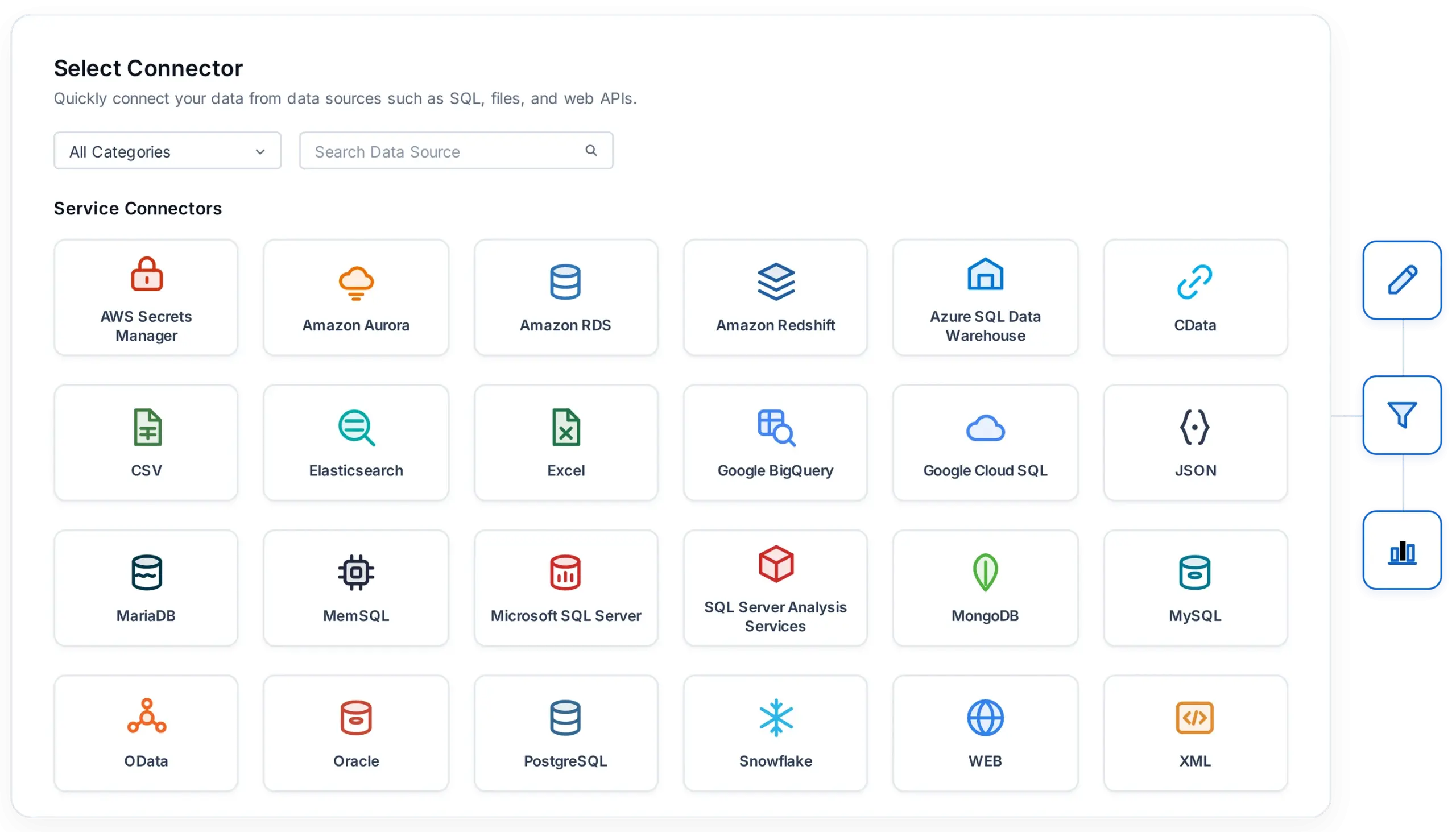
Data Connectors Connect Bold Reports to your data sources
The report designer connects directly to relational databases, cloud data warehouses, NoSQL stores, search engines, flat files, and REST/OData APIs, with no custom code required for standard connections. Every connector below links to a step-by-step setup guide.
27 Connectors
Built-in connectors ready to use
Any Environment
Works across cloud and on-premises
Zero Code
Configure connections without coding
250+ Systems
Extend connectivity through CData
J&J
Schneider
Bridgestone
Siemens
Verizon
HP
Fidelity
Intel
Three steps, no code
From picking a source to a finished report, the whole setup happens inside the designer.
Pick a connector
Choose your data source from the report designer's connector list.
Enter connection details
Fill in the connection dialog, no custom code or drivers to install.
Build your report
Your data source is ready to bind to tables, charts, and other report items.
Popular Connectors
A closer look at four of the most widely used connectors on this page.
CData
Access 250+ additional systems and applications through CData's extensive driver library.
XML
Report directly on structured XML data sources and feeds without conversion.
Snowflake
Cloud-native data platform for warehousing and analytics.
ODBC
Connect to any ODBC-compliant data source using a standard driver connection.
Connecting your data helps you
A consistent connection experience across every data source, built into the report designer.
Skip the code
Standard connections are configured through the report designer's dialogs, no custom code required.
Secure credentials
AWS Secrets Manager retrieves connection credentials securely instead of storing them in plain text.
Reuse connections
Shared data sources let one configured connection power multiple reports without reconfiguring it.
All Data Connectors
0 connectorsRelational Databases
Standard on-premises and self-managed SQL engines for transactional and operational reporting. Connect directly with native drivers, no middleware required.
Microsoft SQL Server
Connect to Microsoft's relational database engine for enterprise reporting.
MySQL
Open-source relational database, widely used for web and business applications.
PostgreSQL
Open-source object-relational database with advanced SQL compliance.
Oracle
Connect to Oracle Database for enterprise-grade relational reporting.
MariaDB
Open-source relational database, drop-in compatible with MySQL.
MemSQL
Distributed SQL database built for real-time analytics at scale.
Cloud Data Warehouses & Managed Databases
Managed and elastic data platforms across AWS, Azure, and Google Cloud. Scale storage and compute independently without managing infrastructure.
Azure SQL Data Warehouse
Microsoft's cloud-scale relational data warehouse.
Amazon RDS
Managed relational database service across multiple engines.
Amazon Aurora
MySQL- and PostgreSQL-compatible cloud database built for high throughput.
Amazon Redshift
Fully managed, petabyte-scale cloud data warehouse.
Google Cloud SQL
Fully managed relational database service on Google Cloud.
Google BigQuery
Serverless, highly scalable enterprise data warehouse
Snowflake
Cloud-native data platform for warehousing and analytics.
NoSQL & Search
Document stores and search/analytics engines for schema-flexible and log-heavy data. Report on unstructured and semi-structured records alongside relational sources.
MongoDB
Document-oriented NoSQL database for flexible, schema-less data.
Elastic Search
Distributed search and analytics engine for log and text-heavy data.
AWS OpenSearch
Managed, open-source search and analytics suite.
Files & Flat Data
Upload or connect to structured file formats directly, no database required. Good for one-off reports or data exported from other systems.
CSV
Report directly on comma-separated value files.
Excel
Connect to Excel workbooks (XLS/XLSX) as a report data source.
JSON
Report on structured JSON data from files or endpoints.
XML
Report on structured XML data sources.
APIs & Universal Connectivity
Standard protocols for connecting to virtually any source, cloud or on-premises. Built for systems without a dedicated Bold Reports connector.
Web API (REST)
Connect reports directly to REST API endpoints.
OData
Query OData-compliant services as a report data source.
OLEDB
Connect to any OLE DB–compliant data source.
ODBC
Connect to any ODBC-compliant data source.
CData
Access 250+ additional systems through CData's driver library.
Analytics & Security
Analytical cubes and credential management services for governed enterprise reporting. Supports multidimensional models and secure connection handling.
Microsoft SQL Server Analysis Services (SSAS)
Connect to OLAP cubes and tabular models for multidimensional reporting.
AWS Secrets Manager
Retrieve database credentials securely at connection time instead of storing them in plain text.
Shared: Not a data source type on its own. Shared data sources let you reuse an existing configured connection across multiple reports without reconfiguring it each time.
No connectors match your filters
Try removing a category filter or clearing your search.
Get the Details You Need
Frequently Asked Questions
Bold Reports supports a wide range of data connectors, including major relational databases (SQL Server, MySQL, PostgreSQL, Oracle), cloud warehouses (Snowflake, BigQuery, Redshift), NoSQL sources (MongoDB, Elastic Search), and file/API formats (CSV, Excel, JSON, XML, REST, OData).
Yes, MongoDB is a supported data connector in Bold Reports Designer.
Every connector on this page links to a step-by-step guide in the Bold Reports documentation.
Yes. Amazon Redshift is a supported cloud data warehouse connector, alongside Azure SQL Data Warehouse, Google BigQuery, and Snowflake.
Yes. Bold Reports connects to Web API (REST) endpoints and OData-compliant services as standard data sources.
Yes. AWS Secrets Manager is a supported connector for retrieving database credentials securely at connection time instead of storing them in plain text.
Yes. Snowflake and Google BigQuery are both supported connectors with dedicated setup documentation.
Yes, Bold Reports supports shared data sources so a single configured connection can be reused across reports without reconfiguring it each time.
No. Standard connections to any of the supported sources are configured through the report designer’s connection dialogs, with no custom code required.
Yes. Bold Reports supports on-premises databases (SQL Server, MySQL, PostgreSQL, Oracle) and cloud sources (Amazon RDS, Google Cloud SQL, Snowflake) side by side.
Use the ODBC, OLEDB, or CData connectors to reach additional ODBC/OLE DB-compliant systems or the 250+ systems supported through CData’s driver library.
Ready to Modernize Reporting the Modern Way?
From migrating legacy reports to embedding reporting in applications, Bold Reports helps you move forward with confidence.
No credit card required.