Audit Reporting Without a GRC Platform

TL;DR:
GRC platforms manage controls, risks, and compliance evidence. Audit reporting automation focuses on generating, scheduling, securing, and delivering audit reports. If spreadsheet-based reporting is a bottleneck, reporting automation may solve the problem without the complexity of a full GRC platform.
Introduction
When organizations run into compliance reporting challenges, the default assumption is often that they need a compliance-management or GRC platform. But many reporting bottlenecks have little to do with controls, risk management, or evidence collection.
In practice, the problem is often narrower: generating recurring reports from business systems, formatting them consistently, delivering them securely to stakeholders, and maintaining a reliable record of access and distribution. These are reporting challenges, not necessarily compliance program challenges.
Spreadsheets can support occasional reporting needs, but recurring audit reporting introduces requirements that are difficult to manage manually, including scheduled delivery, access control, version consistency, and traceable distribution histories. As reporting volumes grow, so does the effort required to keep reports accurate, secure, and on schedule.
This distinction matters because compliance program automation and audit reporting automation solve different problems.
This article explains where spreadsheets break down, how audit reporting automation improves reliability, and when you can improve audit reporting processes without investing in a full GRC platform.
If you are evaluating solutions, see Compliance Reporting Software: A Complete 2026 Guide for a breakdown of tool categories
What is audit reporting?
Audit reporting is the process of generating and maintaining reports used during internal audits, external audits, compliance reviews, and governance activities.
These reports may include financial statements, access reviews, operational summaries, system activity logs, and other documentation that auditors or stakeholders use to evaluate performance, compliance, and risk.
Organizations often associate audit reporting with broader compliance initiatives, but the reporting process itself focuses on producing accurate audit reports, delivering them securely, and maintaining a clear record of access and distribution. As reporting requirements increase, many organizations look for audit reporting software that automates report generation, scheduling, security, and delivery without requiring a full governance, risk, and compliance (GRC) platform.
Not every audit reporting challenge requires new compliance management processes. In many cases, the real bottleneck is the reporting layer itself.
Two different problems get called “compliance reporting”
If you search for help with compliance reporting, you will find GRC platforms designed to continuously monitor security controls, collect audit evidence from cloud systems, and map that evidence to frameworks such as SOC 2, ISO 27001, or HIPAA. These platforms solve important governance and compliance challenges for organizations that need centralized oversight of controls, risks, and audit evidence.
Many organizations, however, arrive at the conclusion that they need to automate audit reporting for a different reason. They already have access to the required data and evidence, but struggle to generate reports consistently, distribute them securely, and ensure stakeholders receive the right information on time.
That is not necessarily a compliance program problem. It is a report generation and delivery problem, and it is one that businesses struggle to solve with spreadsheets alone.
This distinction matters because compliance program automation and audit reporting automation solve different problems. Improving the reporting layer can address a reporting bottleneck without the complexity of adopting a full GRC platform.
Where spreadsheet-based audit reporting actually breaks down
Scoped to the report itself rather than the broader compliance program, the recurring failure points are narrower than they first appear:
Manual scheduling and distribution
Recurring reports get pulled, formatted, and emailed by hand each cycle. When someone’s out, the report is late. When the process is undocumented, there’s no way to prove it happened consistently.
No reliable record of who received which version
Auditors frequently ask not just “is this report accurate?” but “who had access to it, and when?” Email threads and shared drives don’t answer that cleanly.
Formatting and formula errors creep in
Every manual edit to a recurring report is a chance to break a formula, misalign a column, or ship last quarter’s numbers by accident.
Version sprawl
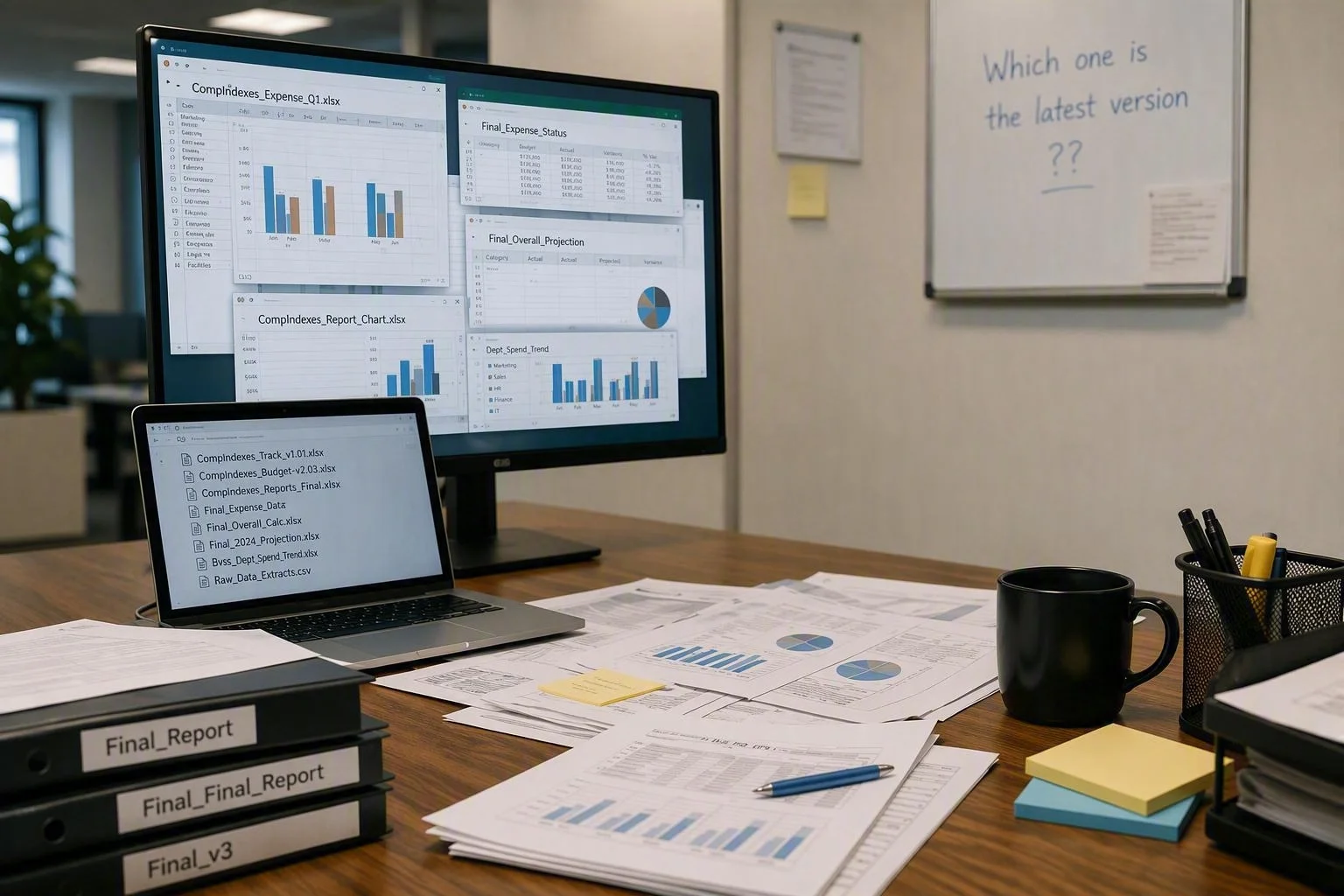
Multiple people saving their own copy of “the” compliance report means there’s often no single authoritative version by the time an auditor asks for one.
Spreadsheet-based vs. automated audit report generation
Audit reports can be generated manually using spreadsheets or automatically through reporting platforms. This table compares the key differences in the report creation and delivery process.
| Evaluation Area | Manual/Spreadsheet-Based | Automated Report Generation |
| Data collection | Manual exporting from each source. | Direct connection to source systems. |
| Scheduling | Set up and sent by an individual each cycle. | Recurring or trigger-based with no manual step. |
| Access control | Shared files, informal permissions. | Role-based access per report or recipient. |
| Delivery record | Email threads, no central log. | Centralized log of who received what and when. |
| Formatting consistency | Prone to manual editing errors. | Same template and rules every cycle. |
| Format flexibility | Usually one format (spreadsheet). | Export to PDF, Excel, Word, CSV, and more. |
| Best fit | Occasional, single-owner reporting. | Recurring reports sent to multiple stakeholders. |
This comparison focuses on how the report itself gets made and delivered. Control monitoring, evidence collection, risk scoring, and framework mapping are typical GRC functions and are intentionally excluded.
What audit reporting software needs to provide
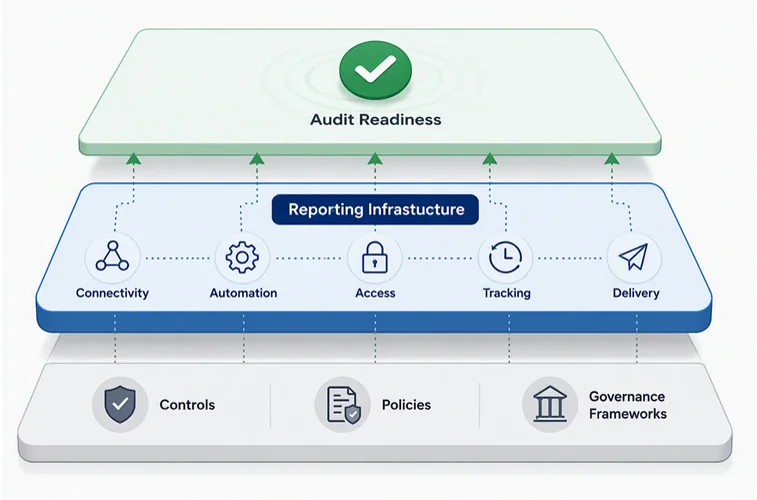
Audit readiness is often associated with controls, policies, and governance frameworks. From a reporting perspective, audit readiness depends on whether reports can be generated consistently, delivered securely, and reproduced on demand. Whether or not you use a GRC platform, audit reporting software should provide:
-
- Direct data connectivity: Pull data from databases, cloud services, applications, and APIs without manual exports.
- Recurring and trigger-based scheduling: Generate and distribute reports on a schedule or based on events.
- Role-based access control (RBAC): Ensure users can view only the reports and data they are authorized to access.
- Report tracking and delivery history: Maintain a record of report generation, distribution, and access activity.
- Multiformat exporting: Deliver reports in PDF, Excel, Word, CSV, and other required formats.
- Embeddability: Make reports available inside business applications, customer portals, and internal systems, not only as email attachments.
Common audit reporting use cases
Financial statement distribution
Recurring statements such as income statements, balance sheets, and management packages generated from connected data sources and delivered to stakeholders on a fixed schedule without manual assembly each cycle.
Access and security reporting
Regular reports showing who has access to what, generated automatically from system data rather than compiled by people individually for each review.
Operational audit packages
Standard report bundles that internal or external auditors expect on a recurring basis—built once as templates and regenerated automatically each cycle.
In each case, the report itself is the deliverable. The reliability of producing it, formatting it, and delivering it on schedule is what gets tested.
How Bold Reports supports audit reporting automation
Bold Reports® is an enterprise reporting platform, not a GRC or compliance-management platform, and it isn’t positioned as one. What it does directly support:
-
- Data connectivity to SQL and NoSQL databases, cloud services, and REST APIs, so reports pull from live sources instead of manual exports.
- Scheduled report generation and delivery, recurring or trigger-based, without manual intervention each cycle.
- Role-based access control governing who can view, export, or manage a given report.
- Multiformat exporting to PDF, Excel, Word, CSV, PowerPoint, and HTML from the same report definition.
- Embedded delivery into web, SaaS, and portal applications, so reports live where stakeholders already work.
If your gap is evidence collection, continuous control monitoring, or framework mapping, that’s a GRC platform’s job. If your gap is getting the actual report produced correctly and delivered reliably, that’s the layer for which Bold Reports is built.
In a Bold Reports customer success story, Dennis Sullivan replaced his SSRS portal with the Bold Reports Report Viewer to improve report access control, expand export capabilities, and strengthen reporting security. He reported immediate return on investment through faster development cycles, improved usability, and more flexible report management. This example demonstrates how organizations can improve report governance and secure report distribution without implementing a full GRC platform.
Final thoughts
Not every “we need to automate compliance reporting” conversation should end with buying a compliance platform. If the actual failure point is manual report assembly, inconsistent scheduling, or no record of what was sent to whom, that’s solvable with reporting automation on its own and it’s often the faster, more targeted fix.
Want to see what automated report generation and delivery looks like against your current process? Start a free trial or request a demo to walk through it with your own data.
Frequently asked questions
- 1.
Do I need a GRC platform or a reporting platform for audit readiness?
It depends. If you need continuous control monitoring and evidence collection across frameworks like SOC 2 or ISO 27001, that’s a GRC platform’s job. If your gap is producing, scheduling, and securely delivering the reports themselves, a reporting platform addresses that directly and doesn’t require a GRC purchase to do it.
- 2.
What’s the difference between compliance automation and automated report generation?
Compliance automation typically refers to ongoing monitoring of controls and automatic collection of audit evidence from connected systems. Automated report generation refers to producing and delivering the reports themselves, pulling data, applying a template, and distributing on schedule. They’re complementary, not interchangeable.
- 3.
Can automated reporting alone satisfy an auditor’s documentation request?
Automated reporting can reliably produce the report and provide a record of when it was generated and delivered. Whether that fully satisfies a given audit request depends on what the auditor is asking for. Reporting automation covers the report itself, not broader control evidence.
- 4.
How does role-based access control on reports support audits?
By restricting who can view, export, or manage a given report and logging that activity, role-based access control provides a clear, reviewable record of who had access to a report and when, which is often what an auditor is asking to verify.
- 5.
Can a reporting platform be used with a GRC platform?
Yes. A reporting platform and a GRC platform serve different purposes and often work together. While a GRC platform manages controls, risks, and audit evidence, a reporting platform automates audit reporting, scheduled report delivery, and secure distribution.