
Choosing a Deployment Model: Cloud vs. On-Premises Reporting
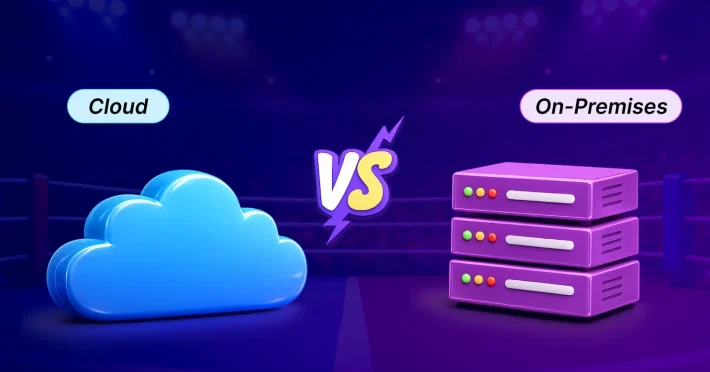
TL;DR: Cloud reporting delivers speed and scalability, while on‑premises reporting offers greater control and regulatory compliance. The right choice depends on your business model, growth strategy, and security requirements. Unlike many reporting tools, Bold Reports allows you to switch between cloud and self-hosted environments without rebuilding reports.
Introduction
Organizations implementing a reporting platform often face an important decision: should reports run in the cloud, or should they stay on-premises? For many teams, this choice is not straightforward. Cloud deployments offer scalability and faster setup, while on-premises environments provide greater control over data and infrastructure. Choosing the wrong approach can affect performance, security, operational costs, and long-term scalability.
This guide explains the differences between cloud and on-premises reporting deployments, when each model works best, and how organizations can choose the right approach for their reporting infrastructure.
Benefits of choosing the right deployment model
The deployment model determines how a reporting platform:
-
- Connects to data sources.
- Processes queries and large datasets.
- Generates reports and dashboards.
- Distributes metrics to users.
Because of this, your deployment model directly impacts:
-
- Scalability: Can your system handle a growing number of users and datasets?
- Performance: How fast are reports generated and delivered?
- Security and compliance: Where does your data live, and who controls it?
- Operational overhead: Who manages infrastructure and updates?
- Cost structure: Capital versus operational expenses.
Modern reporting platforms often support multiple deployment options, allowing organizations to choose the environment that best aligns with their infrastructure strategy.
Understanding Bold Reports deployment models
Bold Reports supports the two primary deployment approaches:
-
- Cloud reporting deployment: The reporting platform runs on cloud infrastructure, and users access reports through a web application.
- On-premises reporting deployment: The reporting platform is installed on servers within an organization’s internal infrastructure.
Bold Reports® supports deployment on cloud infrastructure and on-premises environments. You can choose based your reporting needs. Next, let us explore each deployment model in detail.
Cloud reporting deployment
Cloud reporting deployment platforms operate on cloud infrastructure, allowing users to access dashboards and reports through the internet without managing local reporting servers. They can be deployed on managed cloud platforms s , enabling scalability, high availability, and reduced infrastructure maintenance.
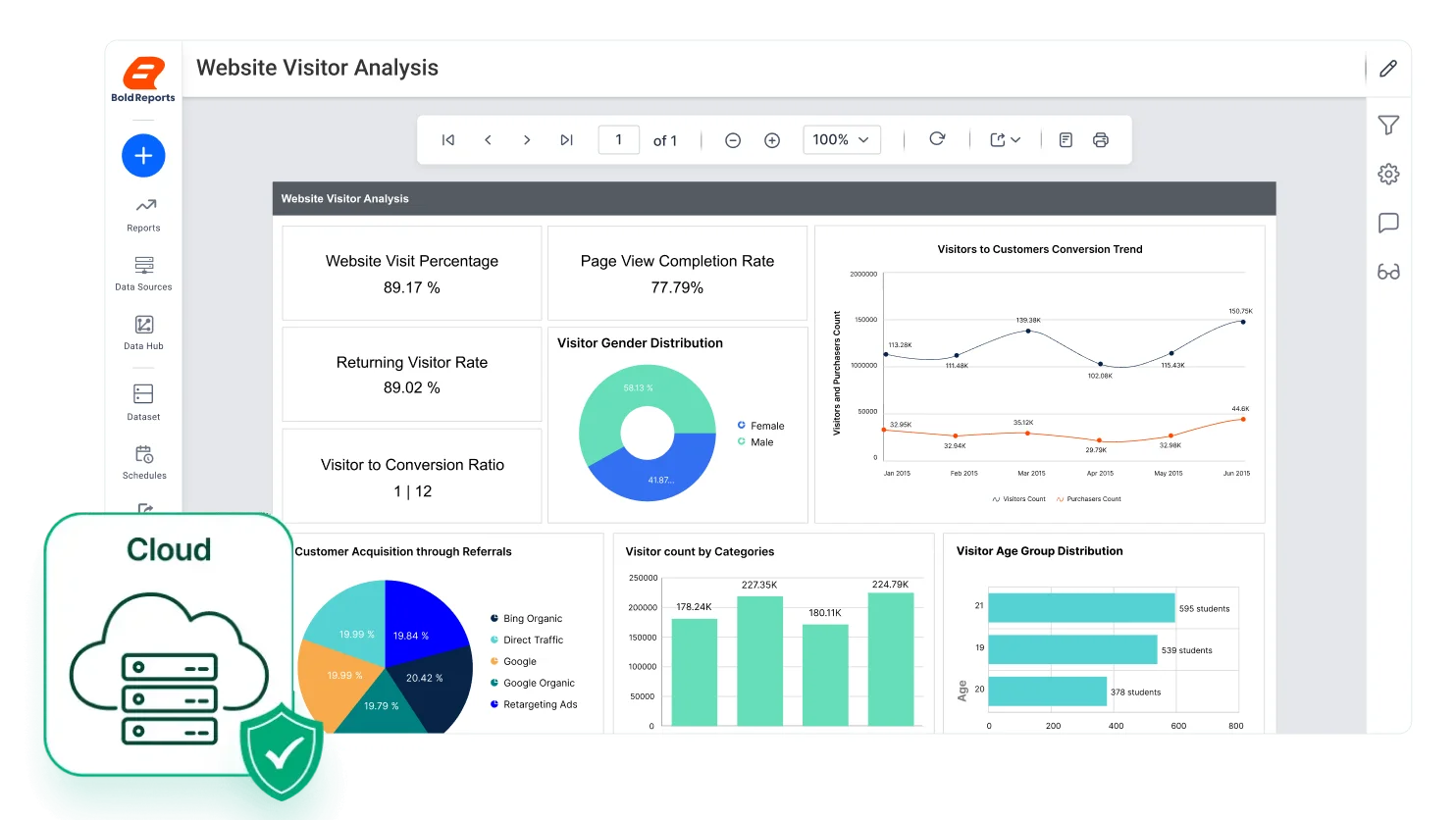
Key benefits of cloud reporting
-
- Faster deployment: Cloud reporting platforms can be set up quickly without installing or configuring internal servers. Organizations can begin building and sharing reports much faster.
- Reduced infrastructure management: Because infrastructure is hosted externally, IT teams spend less time managing servers, updates, and system maintenance.
- Flexible scalability: Cloud environments can scale automatically to support increasing data volumes, additional users, or growing reporting workloads.
- Access anywhere: Cloud reporting enables teams and stakeholders to access reports from any location through secure web access.
For SaaS products embedding reporting into customer-facing applications, cloud deployment often provides the flexibility needed to serve thousands of users.
On-premises reporting deployment
On-premises reporting deployment systems run within an organization’s internal infrastructure, where servers, security policies, and system configurations are fully managed by internal IT teams. They can be deployed on Windows or Linux servers, as well as containerized environments using Docker and Kubernetes, providing full control over deployment, security, and performance.
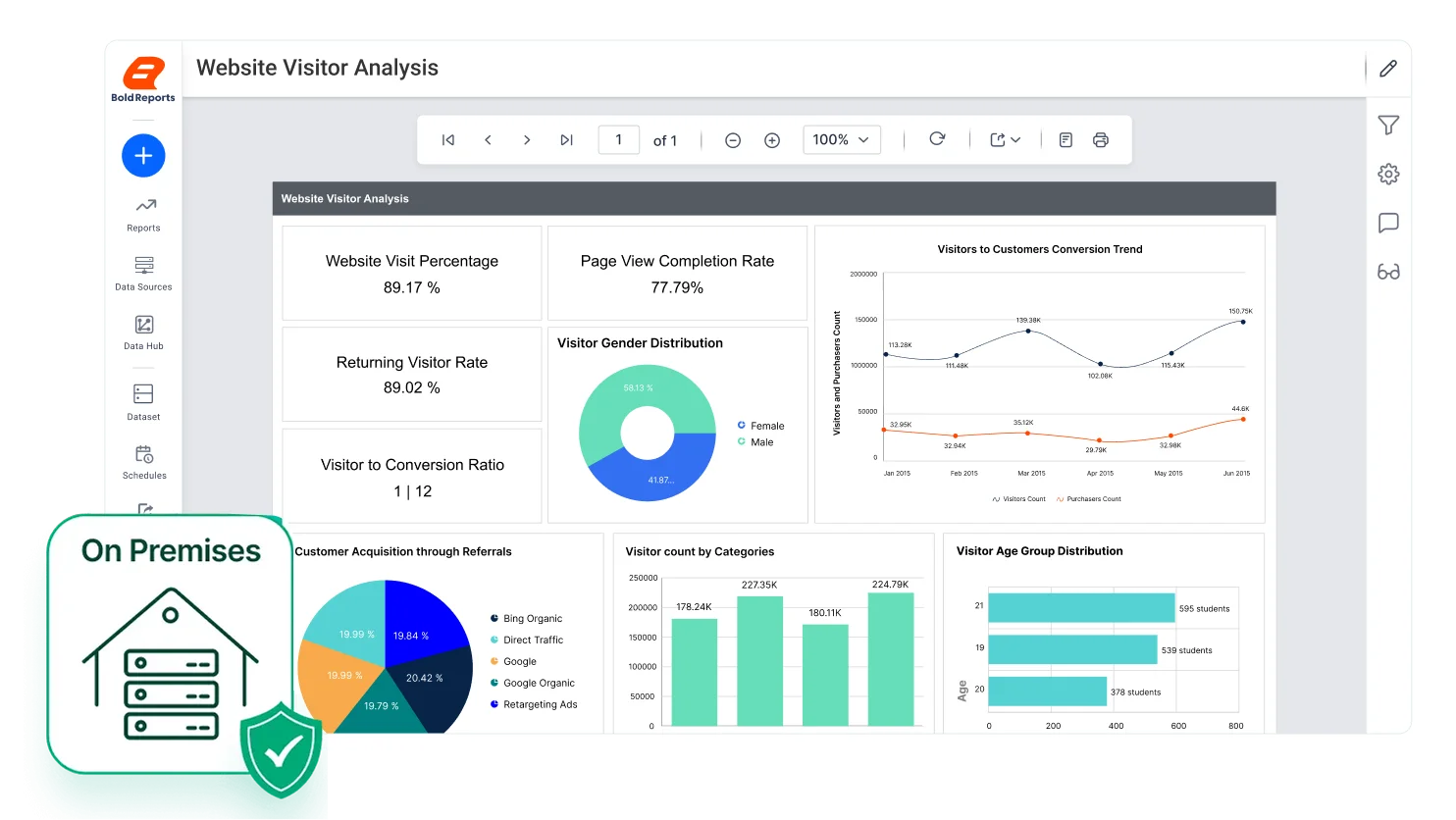
Key benefits of on-premises reporting
-
- Full infrastructure control: Organizations can configure and manage reporting servers according to their internal architecture and performance requirements.
- Strong data governance: Sensitive information remains within the organization’s network, helping meet strict security and compliance standards.
- Custom security configuration: Internal authentication systems, network rules, and security policies can be configured according to organizational requirements.
- Support for restricted environments: On-premises reporting systems can operate in environments where internet connectivity is limited or restricted.
Industries such as finance, healthcare, and government sectors frequently rely on on-premises reporting systems to maintain strict data governance.
Cloud vs. on‑premises reporting deployment comparison
Both deployment models support reporting, but they differ in infrastructure management, scalability, and operational responsibilities.
| Aspect | On-premises reporting | Cloud reporting |
| Infrastructure | Hosted on internal servers | Hosted on fully managed cloud infrastructure |
| Control | Full control over systems, data, and configurations | Shared responsibility with the cloud provider |
| Security management | Customizable security settings to meet compliance requirements | Enterprise-grade security with strong protection and cloud compliance |
| Compliance & isolation | Ideal for strict compliance and private or isolated networks | Meets standard enterprise security requirements |
| Maintenance | Handled by your internal teams | Updates and maintenance included automatically |
| Update control | You control patching and version upgrades | Automatic updates with access to the latest features and fixes |
| Scalability | Requires additional infrastructure investment | Easily scalable on demand |
| Accessibility | Typically limited to internal or private network access | Accessible from anywhere |
| Deployment speed | Requires setup and configuration | Quick setup with immediate access |
Understanding these differences helps organizations determine which deployment model best aligns with their operational requirements.
How to choose the right deployment model
Choose cloud if:
-
- You are building a SaaS product.
- You expect rapid user growth.
- You want minimal infrastructure management.
Choose on-premises if:
-
- You handle sensitive or regulated data.
- You need full infrastructure control.
- Your organization restricts cloud usage.
Evaluating these factors helps organizations select the reporting deployment model that aligns with their long-term analytics strategy.
Choose the deployment that fits your needs
Choosing between cloud and on‑premises reporting isn’t about following trends; it’s about alignment. Cloud reporting delivers speed and scalability, while on‑premises reporting offers greater control and compliance. The right choice depends on your business model, growth strategy, and security requirements.
Unlike many reporting tools that force you into a single deployment model, Bold Reports allows you to switch between cloud and self-hosted environments based on your business needs, without rebuilding reports.
Deploy your reporting server in your preferred environment and test how it performs with your real data. If you’re evaluating reporting solutions, the best way to decide is to try it in your own environment. Sign up for a 30-day free trial to experience Bold Reports firsthand or book a personalized demo to see how it can work for your team.
Frequently asked questions
- 1.
What is a reporting deployment model?
A reporting deployment model defines where and how reporting software is hosted and operated. Organizations typically deploy reporting platforms either in the cloud or within their own infrastructure through on‑premises servers.
- 2.
What deployment models does Bold Reports support?
Bold Reports supports both cloud deployment and self‑hosted on‑premises deployment, giving organizations flexibility in how they run their reporting platform.
- 3.
Is Bold Reports secure?
Yes, Bold Reports is built to support enterprise security needs. It uses SSL/TLS encryption to protect data in transit, role‑based access control to manage user permissions, and other enterprise‑grade security features to safeguard sensitive reporting data.
- 4.
What is Bold Reports self‑hosted or on‑premises deployment?
Bold Reports on‑premises (self‑hosted) deployment is installed and run on your own servers. This model provides full control over data, security configurations, and the deployment environment, making it suitable for organizations with strict compliance, private networks, or specific data governance requirements.





The points on deployment strategy really resonated with me. It’s interesting to see how reporting needs, team collaboration, and data security all intersect when deciding between cloud and on-premises options. Considering these factors upfront seems crucial for making the right choice for any organization.