Cloud Reporting Explained: What It Is and 5 Benefits

Introduction
Many teams still use outdated reporting systems that slow decision-making and limit scalability. This often leads to delayed decisions and missed opportunities. Cloud reporting solves this challenge by offering secure access to data from anywhere, enabling faster decisions. This blog explores what cloud reporting is, its top five benefits, and its key differences with traditional reporting.
What is cloud reporting?
Cloud reporting refers to the process of generating, managing, and sharing reports using cloud-based platforms or services. Instead of relying on desktop software, cloud reporting tools operate over the internet, allowing users to access data and reports from anywhere, collaborate in real time, and scale resources as needed.
Now that we’ve clarified what cloud-based reporting entails, let’s dive into its benefits.
5 benefits of cloud reporting
Cloud reporting offers several benefits that make it a strategic choice for modern organizations. They include: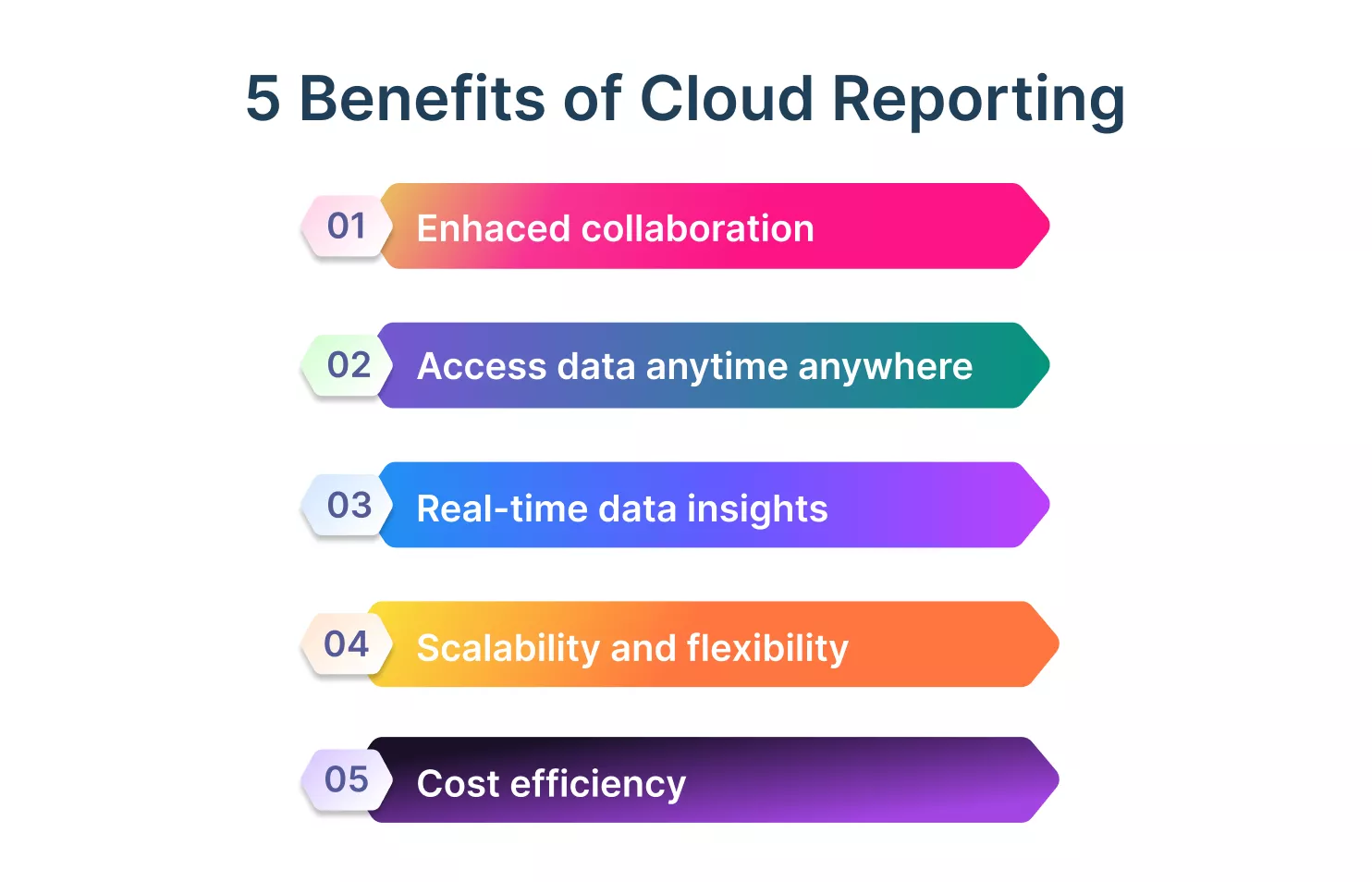
1.Access data anytime, anywhere: Cloud reporting enables users to securely access dashboards and reports from any location and device. Whether you’re working remotely, traveling, or in the office, your data is always available, supporting faster, more flexible decision-making.
2. Real-time data insights: Cloud platforms integrate with live data sources, ensuring that reports reflect the most current information. This empowers teams to make timely decisions based on accurate, up-to-date metrics.
3. Scalability and flexibility: As your organization grows, cloud reporting solutions scale effortlessly. You can expand data capacity, add users, or enhance reporting features without investing in additional hardware or infrastructure.
4. Cost efficiency: By eliminating the need for on-premises servers and reducing IT maintenance, cloud reporting lowers operational costs. Subscription-based pricing models also make budgeting more predictable and manageable.
5. Enhanced collaboration: Cloud reporting fosters teamwork by allowing multiple users to view, edit, and share reports in real time. Features like commenting, version control, and secure sharing improve transparency and accelerate decision-making across departments.
With a clear understanding of the benefits, let us now compare the traditional and cloud reporting tools.
Key differences between cloud reporting and traditional reporting
As organizations increasingly embrace remote work, real-time data access, and scalable infrastructure, the decision between cloud-based and traditional reporting solutions has become more strategic. Understanding their core differences can help you align your reporting strategy with your business goals and digital maturity.
| Feature | Cloud reporting | Traditional reporting |
| Deployment | Web-based, hosted on cloud platforms | Installed and maintained on-premises |
| Cost efficiency | Subscription-based, pay-as-you-go | Capital expenditure for hardware and software |
| Accessibility | Accessible from anywhere with internet | Limited to internal networks or VPN |
| Maintenance | Managed by vendor (automatic updates) | Requires in-house IT support |
| Scalability | Easily scalable with business growth | Limited by physical infrastructure |
With a clear understanding of the differences between cloud and traditional reporting, organizations can choose a model that aligns with their business needs.
Next, let’s explore some of the reasons why you should choose Bold Reports® for your cloud reporting.
Why choose Bold Reports for cloud reporting
As organizations shift toward cloud-first strategies, the need for scalable, secure, and collaborative reporting tools becomes essential. Bold Reports offers a comprehensive cloud-based reporting solution that simplifies data access, report creation, and distribution across teams.
With Bold Reports, users can seamlessly deliver insights within their cloud environment. It allows developers and business users to create, manage, and share reports without infrastructure overhead. To help teams get started, Bold Reports offers a free tier for cloud deployments, giving users hands-on experience at no cost.
1. White-label reporting: Bold Reports lets you embed advanced reporting tools customized with your company logo, colors, and identity, without building from scratch.
2. Data visualizations: Bold Reports lets you create interactive, visually rich reports that make it easier to analyze trends, track KPIs, and share results. With clear data visualizations, you gain insights faster and communicate findings more effectively.
3. Pixel-perfect reporting: Bold Reports ensures pixel-perfect layouts for screen and print, helping users deliver clear, professional reports across formats.
4. Multitenant support: Bold Reports lets SaaS providers and enterprises manage multiple users from a single platform. With robust tenant isolation and centralized control, you can scale efficiently without compromising security or performance.
5. Flexible deployment: Bold Reports offers flexible deployment—cloud or on-premises—so you get secure, scalable reporting tailored to your business needs.
6. Transparent pricing: Bold Reports offers flexible, easy-to-understand pricing with unlimited reports and no hidden fees, giving you full value without hidden costs.
7. User-friendly self-service reporting: Designed for users of all skill levels, Bold Reports enables independent data exploration and report creation, reducing IT dependency and speeding up decision-making across teams.
Flexible deployment options in Bold Reports
Cloud-based reporting platforms can be deployed in various ways depending on your organization’s data strategy, compliance needs, and infrastructure setup. The main deployment options in Bold Reports are:
- On-premises deployment: Host Bold Reports on your own servers to maintain complete control over your data and reporting environment. Customize security settings to meet compliance requirements and operate in offline or restricted environments without external access.
- Cloud-neutral deployment: Enjoy the freedom to deploy Bold Reports on any public cloud provider. This cloud-based approach supports your infrastructure strategy without locking you into a single vendor.
- Fully managed cloud hosting: Let us manage the infrastructure while you focus on data insights. With Bold Reports hosted in the cloud, benefit from instant access, automatic updates, and enterprise-grade security.
- Hybrid infrastructure: Bold Reports supports a wide range of hybrid deployment environments—Docker, Kubernetes, Linux/Windows servers, and Azure App Service—offering agility, scalability, and control over your reporting infrastructure.
Bold Reports lets you choose the model that best aligns with your business requirements and infrastructure.
Transform your data with cloud reporting
Cloud reporting gives businesses faster access to data and real-time insights. To explore more advantages, check out the blog The 5 Hidden Benefits of Cloud-Based Reporting Tools. Bold Reports® stands out for its intuitive interface, powerful features, and flexible deployment that make reporting simple for any organization.
What are you waiting for? Sign up for a free trial or request a free demo to enhance your reporting capabilities. We also provide an onboarding guide for new users. Get started now!