Ad Hoc Reporting: What It Is, Key Features and Use Cases

TL;DR: Ad hoc reporting enables on-demand data exploration without heavy IT dependency. It empowers teams to build, customize, and analyze reports instantly using real-time data.
Introduction
Business questions do not wait for scheduled reports, and teams cannot afford to wait for insights. Developers and IT departments are often overwhelmed by urgent requests like:
-
- “Can you filter this by region?”
- “What changed this quarter?”
Standard reporting is not built for this purpose. Each new question requires manual updates, causing delays and leaving businesses waiting for answers they need immediately.
This is where ad hoc reporting becomes essential. Ad hoc reporting is the ability to create on-demand, custom reports by selecting fields, filters, and groupings at runtime, so users can answer new business questions without waiting for a developer-built report. This blog explores what ad hoc reporting is, why businesses need it and how Bold Reports® supports interactive and ad hoc reporting.
What is ad hoc reporting?
Ad hoc reporting is an on-demand reporting approach that enables users to create custom reports instantly to answer specific business questions. Unlike standard reports, ad hoc reports are generated as needed, without predefined report formats or fixed templates.
This approach empowers users to explore data freely and respond quickly to changing business needs.
With ad hoc reporting, you can:
-
- Select data fields dynamically based on current requirements.
- Apply filters and conditions to narrow results.
- Drill down into details for deeper analysis.
- Analyze available data in real time.
- Generate insights without relying on predefined report rules.
All of this can typically be done without relying on IT teams or developers, allowing business users to make faster, data-driven decisions with greater flexibility.
What are the benefits of ad hoc reporting?
Ad hoc reporting empowers organizations to explore data quickly, answer emerging questions, and make informed decisions without waiting on long development cycles. This matters for:
- Faster decision-making: Ad hoc reporting provides instant, on-demand insights, reducing repetitive report requests and enabling teams to act quickly while IT focuses on higher-priority work.
- Empowered teams: Easy-to-use reporting tools allow users to create and modify reports without deep technical skills, minimizing dependency on developers, and boosting overall efficiency.
- Customized insights: Teams can tailor each report by applying filters, grouping data, and adjusting layouts, eliminating the need for multiple fixed reports and ensuring insights fit specific business scenarios.
- Improved productivity: Self-service capabilities cut down on back-and-forth communication for routine reports, allowing IT and development teams to redirect their time toward strategic initiatives.
- Real-time data exploration: By connecting directly to live data sources, ad hoc reports ensure users access the most current information, supporting accurate, timely decisions.
With a clear understanding of why ad hoc reporting matters, let’s look at the key features to evaluate in an ad hoc reporting tool.
What features should an ad hoc reporting tool include?
Below are the essential features that define effective ad hoc reporting tools and enable users to access, analyze, and customize data with greater speed and flexibility.
- Intuitive, self‑service interface: Enables users to build and modify reports without technical expertise, often through drag‑and‑drop design.
- Real-time data access: Connects directly to live data sources to ensure decisions are based on the most current information.
- Flexible customization options: Allows users to apply filters, sorting, grouping and layout adjustments to fit specific analytical needs.
- Interactive exploration: Offers drill‑down, drill‑through, and interactive sorting to uncover deeper insights within the same report.
- Reusable components: Supports report parts or templates that users can quickly assemble to create new reports.
- Secure data access controls: Ensures users only see data relevant to their roles through governed permissions and authentication.
Now that we’ve covered how ad hoc reporting works, let’s explore its real-time use cases.
Use cases of ad hoc reporting
Some of the real-time use cases of ad hoc reporting include:
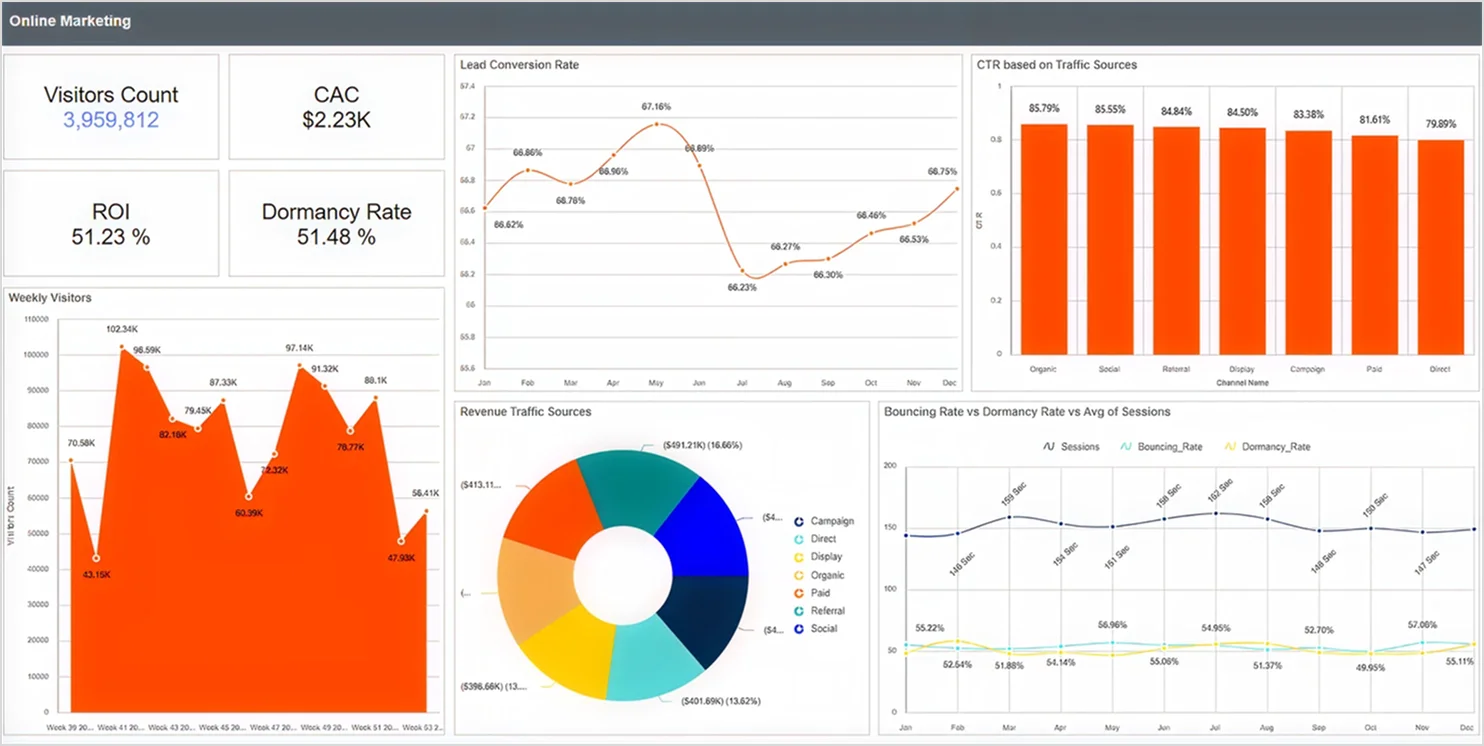
Digital marketing industry: Online marketing performance report
In digital marketing, teams often struggle to compare insights because traffic data, conversion metrics, and engagement results come from multiple platforms. The online marketing report solves this by unifying key indicators such as conversion trends and bounce rates into a single, accurate view of real-time campaign performance.
Retail industry: Sales analysis report
Sales teams often find it difficult to assess regional performance when product, order, and geographic data are spread across multiple systems. Ad hoc reporting enables users to create custom reports that consolidate this data into a unified view. The sales analysis report brings together product rankings, order quantities, and total sales to deliver accurate, real-time insights, supporting more effective sales planning and decision-making.
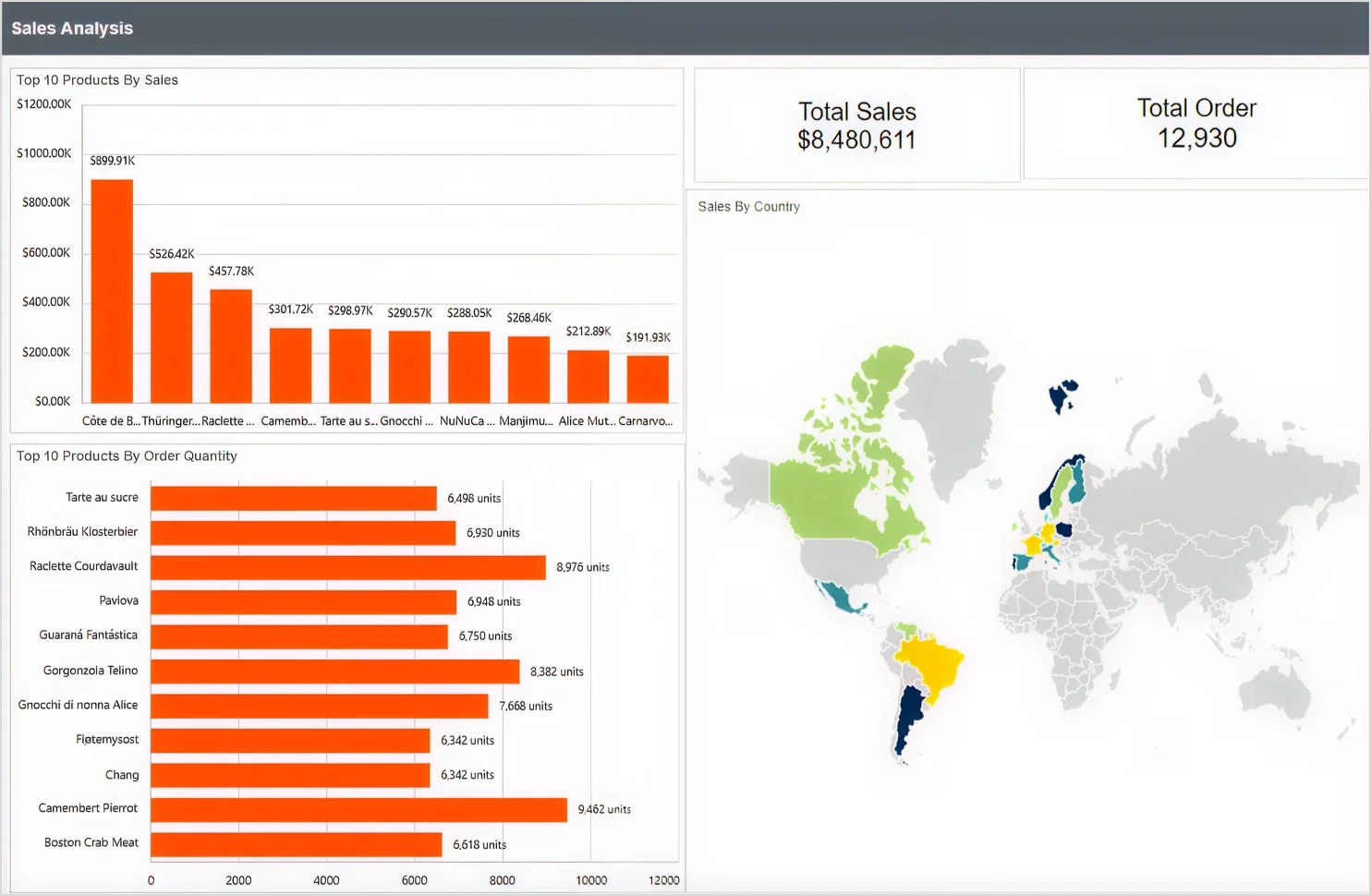
Explore Bold Reports report samples to see how it works. You can also create, edit, delete, and view reports, modify data sources, and apply row-level filters based on the logged-in user.
How does Bold Reports support ad hoc reporting?
Bold Reports® enables powerful ad hoc reporting through interactive, parameter-driven, and self-service capabilities that allow users to:
-
- Analyze up-to-date information using live or connected data sources.
- Apply filters, parameters, grouping, and sorting to answer specific business questions.
- Drill down into reports and interactively explore data for deeper insights.
- Create and modify reports independently, without heavy reliance on IT or development teams.
- Build custom reports on demand without being constrained by predefined report structures.
Ad hoc reporting plays a critical role in helping teams access timely insights, explore data freely, and generate customized reports without complex workflows or technical barriers. With the right tools, organizations can respond quickly to changing business needs and transform raw data into actionable intelligence.
What are you waiting for? Sign up for a free trial today or request a personalized demo to see Bold Reports in action. New to the platform? Schedule an onboarding call and let our product experts guide you through your first steps with ease.
Frequently asked questions
-
- 1.
What is Bold Reports self-service reporting?
Bold Reports is an easy-to-use platform for creating and sharing reports. It helps individuals and teams explore data through a simple interface that does not require technical skills.
- 2.
What data sources are supported, and do I need technical skills?
You can connect to SQL, REST APIs, Excel, cloud apps, and other sources. Users can drag, drop, and customize reports, while developers may use APIs if needed.
- 3.
Is it secure, and can I host it myself?
Yes. Bold Reports includes security features such as multi-factor login, single sign-on, and row-level access. You can host it on Windows, Linux, Docker, Kubernetes, or Azure App Service.
- 4.
Can I embed reports and customize the experience?
Yes. Reports can be embedded into applications built with Angular, Blazor, ASP.NET Core, and other frameworks. It also supports multitenancy and white-label customization.
- 5.
Where can I learn more about it?
Visit our Learn Center for quick guides or join the Academy for hands-on training and in-depth courses.
- 1.