Embedded Reporting for SaaS: Drive Retention in 2026
TL;DR
Embedded reporting delivers real-time, in-app reports without external tools, improving the user experience, retention, and revenue. Organizations can reduce development timelines from 6 months to a few weeks, accelerating time-to-market and reducing engineering effort. Adoption is growing rapidly, with over 80% of users preferring embedded reporting and organizations reporting 30 to 40% lower churn and higher engagement among active users.
Introduction
Modern SaaS users expect instant, in-app insights, but many platforms still rely on fragmented analytics tools and delayed reporting. This disconnect disrupts the user experience and leads to missed opportunities in revenue growth and customer retention.
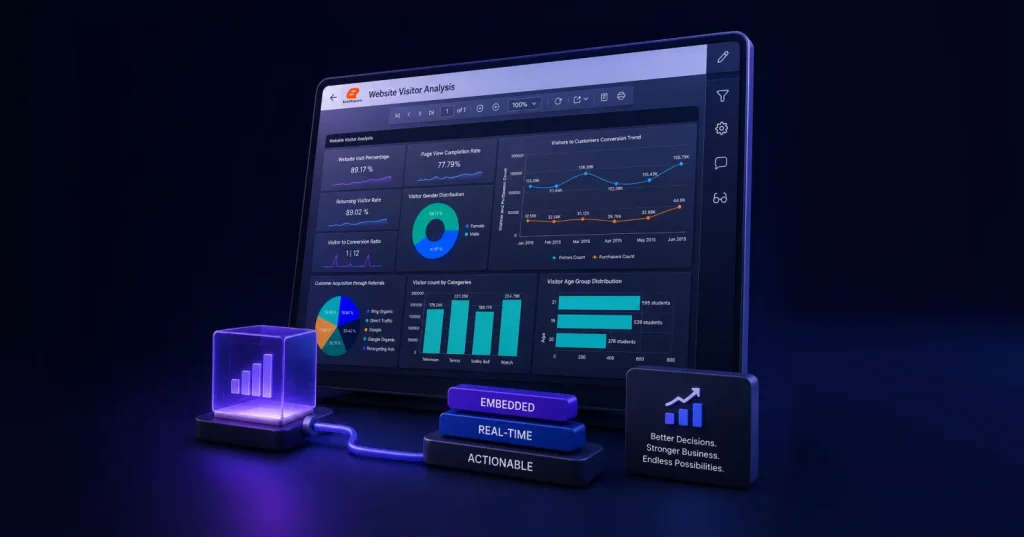
Embedded reporting solves this by delivering real-time insights within SaaS applications, transforming raw data into actionable intelligence. It enables faster, data-driven decision-making without leaving the platform, making it a critical capability for modern SaaS platforms and the future of business intelligence in 2026.
This guide covers the key benefits, use cases, and best practices for implementing embedded reporting in SaaS applications.
What is embedded reporting for SaaS?
Embedded reporting for SaaS is the integration of reporting capabilities directly into a SaaS application, allowing users to access insights without leaving the platform. Unlike dashboards, it delivers a seamless, in-context experience designed for structured, decision-ready outputs.
It allows users to access and interact with insights directly within their workflow and to generate structured, export-ready outputs instantly. Embedding reporting directly into the product ensures consistency and supports reliable, data-driven decision-making.
Why embedded reporting is becoming a SaaS must-have in 2026
Embedded reporting has become essential for modern SaaS platforms, transforming how users access and act on data. In 2026, it plays a key role in delivering faster, more intuitive, and data-driven experiences.
1. In-app reporting is now a product expectation
Users no longer want to switch between tools, as it disrupts workflows and slows productivity. Embedded reporting enables:
-
- Access to insights directly within the application.
- Higher user engagement and retention.
- Increased product adoption.
This creates a seamless, integrated experience that keeps users inside your platform.
2. Demand for real-time insights
Delayed data slows decisions and leads to missed opportunities. With integrated reporting:
-
- Users access live data instantly.
- Decisions are made faster.
- Teams respond quickly to changing conditions.
This empowers organizations to act with speed and confidence.
3. Rise of AI-powered reporting
AI is redefining embedded analytics, making reporting more intelligent and user-friendly. Key capabilities include:
-
- Predictive analytics and forecasting.
- Automated insights and recommendations.
- Natural language queries.
This makes data accessible to non-technical users while reducing reliance on data teams.
4. Personalized data experience
Generic and static reports no longer meet modern user expectations in SaaS applications. Embedded reporting supports:
-
- Role-based access.
- Customized data views.
- User-specific insights.
This ensures that every user sees relevant, actionable information tailored to their needs.
5. Eliminating data silos with unified reporting
Data often lives in disconnected systems, creating inefficiencies and inconsistencies. In-app reporting helps by:
-
- Bringing data into a single interface.
- Improving cross-team collaboration.
- Delivering consistent, accurate insights.
This leads to better alignment and smarter decision-making across the organization.
How embedded reporting works in SaaS applications
Embedded reporting connects data sources, processing layers, and reporting engines to deliver secure reports inside the application interface, creating a seamless user experience.
Step-by-step process of embedded reporting
1. Data collection from multiple sources
Embedded reporting starts by retrieving data from:
-
- Databases (SQL, cloud data warehouses).
- APIs and third-party services.
- Internal application data.
This ensures reports are built using the most up-to-date information.
2. Data processing and transformation (ETL)
The collected data is processed through ETL or ELT pipelines, including:
-
- Cleaning and structuring.
- Aggregation and filtering.
- Preparing for reporting.
This step ensures data consistency and reliability across reports.
3. Report generation using a reporting engine
The reporting engine processes the prepared data by:
-
- Running queries on processed data.
- Applying business logic.
- Generating structured or pixel-perfect reports.
These reports can include tables, charts, invoices, or compliance documents.
4. Embedding reports into the SaaS application
Reports are embedded directly into the application using:
-
- REST APIs and SDKs.
- JavaScript components.
- Embedded viewers or iframes.
This allows reports to appear as a native part of the user interface, without redirecting users.
5. Real-time access and user interaction
Users can interact with embedded reports by:
-
- Viewing reports instantly.
- Applying filters and parameters.
- Exporting or interacting with insights.
This enables faster, data-driven decision-making within the application workflow.
6. Security, access control, and multi-tenant architecture
Modern embedded reporting ensures secure data access through:
-
- Role-based access control: Limits data visibility by user roles.
- Multi-tenant isolation: Keeps customer data separated in SaaS environments.
- Token-based authentication: Ensures secure access via backend-controlled credentials.
Security is a critical component of embedded reporting in modern SaaS systems.
Embedded reporting vs. embedded analytics: Key difference for SaaS buyers
To understand embedded reporting, it’s important to compare it with embedded analytics.
| Factor | Embedded reporting | Embedded analytics |
| Definition / purpose | Delivers structured, predefined, and pixel-perfect reports within applications | Delivers interactive, exploratory, and insight-driven dashboards within applications |
| Business value | Ensures consistency, compliance, and operational clarity | Drives engagement, insights, and data-driven decisions |
| Typical outputs | Pixel-perfect reports, operational reports, invoices, and financial statements | Interactive dashboards, KPIs, drill downs, charts, and predictive insights |
| Data perspective | Historical and descriptive data | Real-time, predictive, and prescriptive insights |
| Use cases | Billing, invoices, compliance, audit-ready exports, and regulatory and standardized reporting | Product analytics, user behavior insights, performance monitoring, and data-driven decision-making |
| Interactivity level | Moderate (filters, parameters, pagination, and sorting) | High (drill-down, slice-and-dice, cross-filtering, and ad-hoc analysis) |
| User experience | Guided and structured for consumption | Flexible and exploratory for analysis |
In short, embedded reporting focuses on structured, export-ready reports, while embedded analytics enables interactive dashboards and deeper analysis. Most SaaS platforms benefit from using both.
Top embedded reporting trends SaaS teams can’t ignore in 2026
Embedded reporting is evolving rapidly in SaaS, focusing on smarter, faster, and more user-centric experiences.
Here are the key trends shaping it in 2026:
-
- AI-powered embedded reporting: AI is transforming embedded reporting with automated insights, anomaly detection, and natural language queries, making data easier to understand and act on.
- Real-time data insights: Modern SaaS platforms are moving toward real-time reporting, enabling instant visibility into performance and faster, data-driven decisions.
- Self-service reporting: Users expect control over their data. Self-service reporting allows them to create, customize, and explore reports without relying on technical teams.
- Fully branded reporting: SaaS applications are prioritizing seamless user experiences with fully customizable, branded reports that feel native to the product.
- API-first and scalable architecture: API-driven reporting solutions provide flexibility, faster integration, and scalability to support growing data and user demands.
Build vs. buy: What teams should consider
For modern SaaS products, how you implement embedded reporting impacts speed, cost, and scalability. The key decision isn’t whether to offer embedded reporting, but whether to build it in-house or choose a ready-made solution to accelerate time to market.
| Factor | Build embedded reporting | Buy embedded reporting (e.g., Bold Reports) |
| Time to market | Months or years to develop | Days or weeks for deployment |
| Development cost | High upfront and long-term costs | Lower and predictable cost |
| Engineering effort | Requires dedicated internal teams | Minimal internal effort required |
| Customization | Full control over features and design | High flexibility within platform capabilities |
| Maintenance | Continuous updates, fixes, and scaling required | Managed by vendor with regular updates |
| Scalability | Complex to scale, especially for multitenant systems | Built-in scalability for growing data and users |
| Security & multi-tenancy | Must build and manage from scratch | Enterprise-grade security included |
| Opportunity cost | Diverts focus from core product development | Frees teams to focus on innovation |
| Risk | Higher risk of delays, bugs, and technical debt | Lower risk with proven solution |
| ROI | Slower return due to long development cycles | Faster ROI with quick implementation |
Industries that depend on embedded reporting
Embedded reporting delivers real-time insights across industries, improving visibility and decision-making.
1. Manufacturing
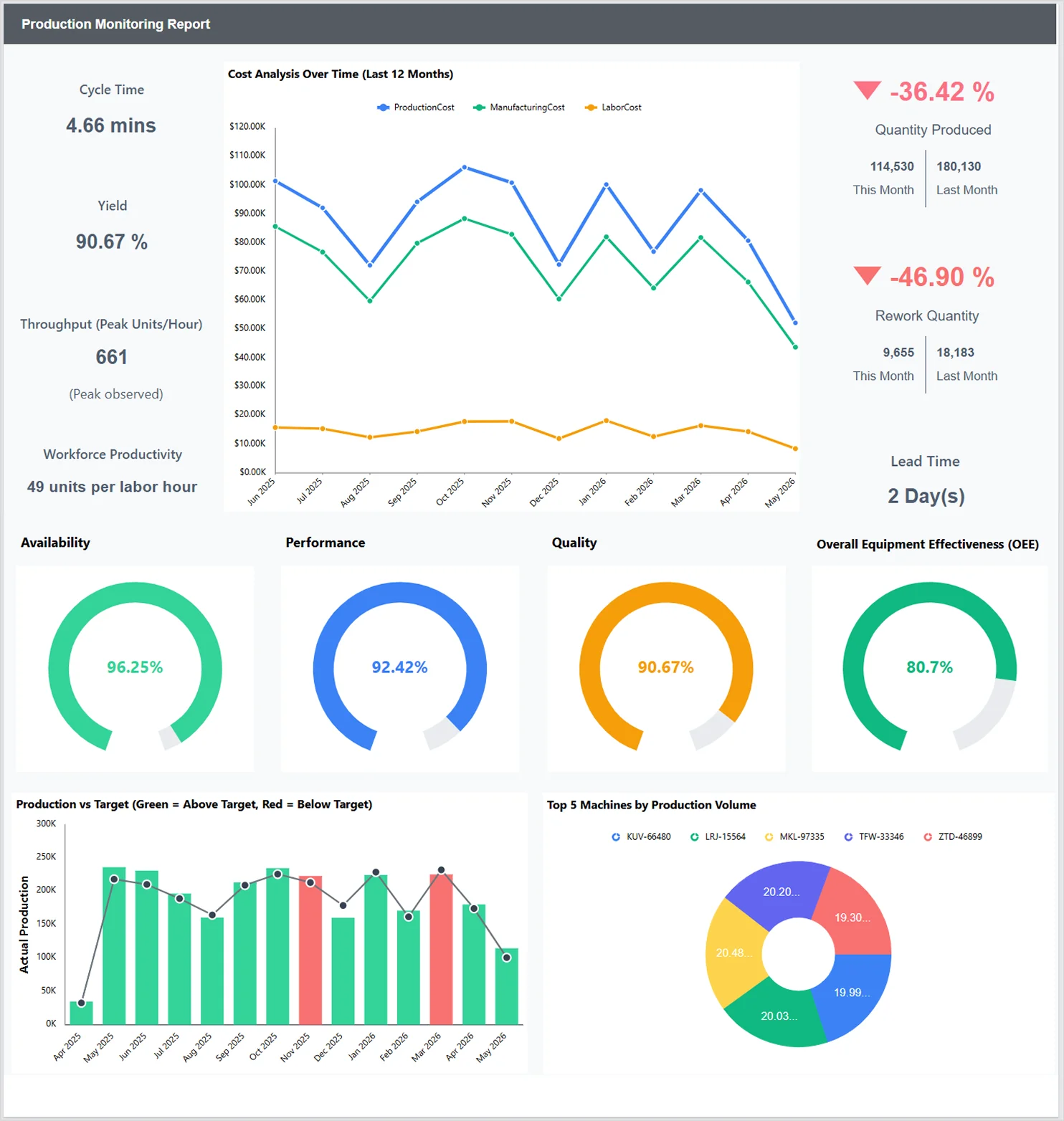
Manufacturers rely on multiple systems to monitor production output, machine performance, and quality metrics across facilities. However, data often remains fragmented across ERP systems, IoT sensors, and legacy tools, limiting real-time visibility.
With reporting built into manufacturing platforms:
-
- Production efficiency increases with real-time tracking of output and bottlenecks.
- Downtime is minimized through continuous machine monitoring.
- Quality improves with visibility into defects and compliance.
By integrating reporting into manufacturing workflows, organizations shift from delayed insights to continuous operational visibility and optimization.
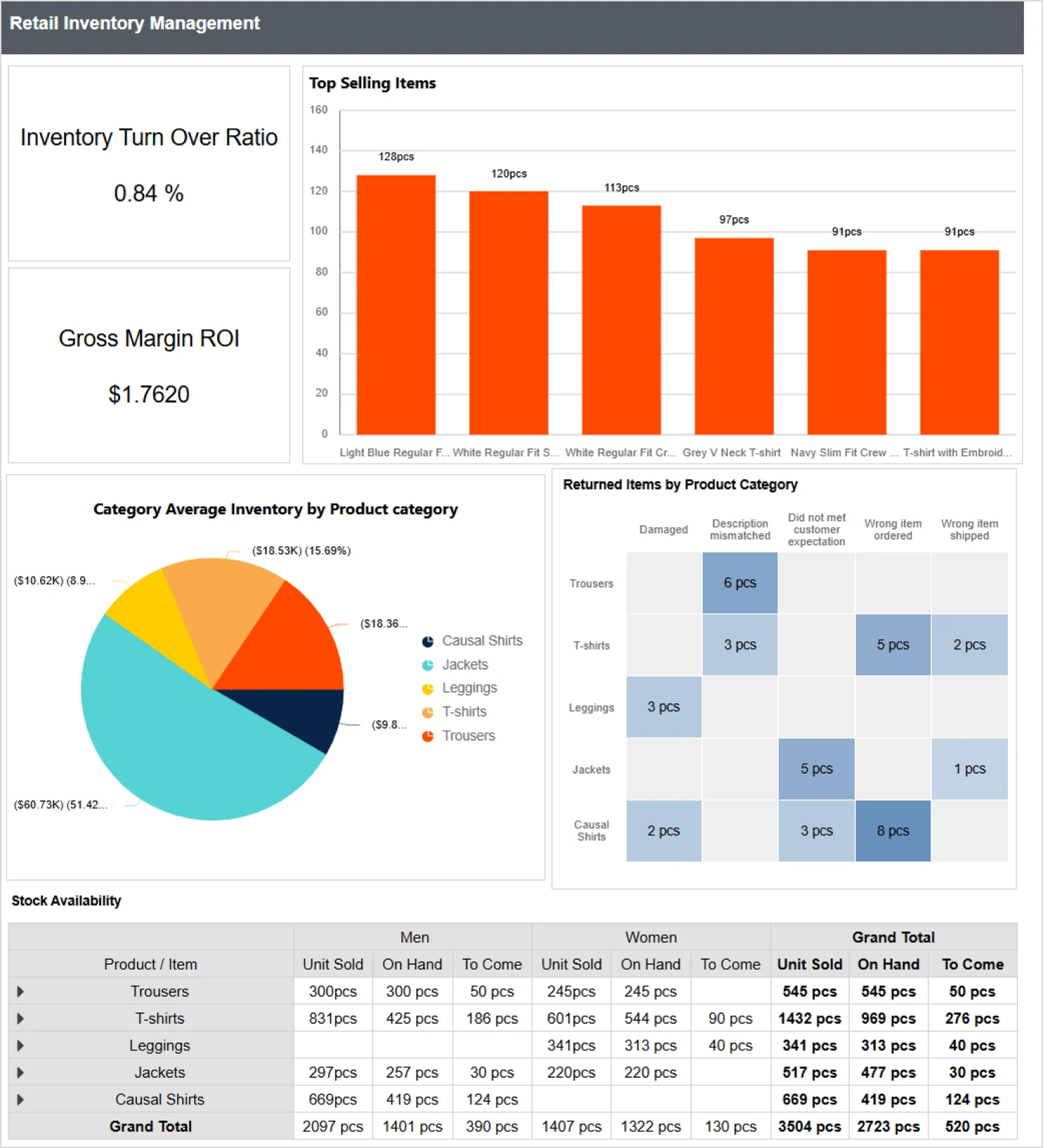
2. Retail
Retail executives and store manager teams manage data across POS systems, e-commerce platforms, and inventory tools, often resulting in disconnected insights that delay response to market demand. With in-app reporting capabilities:
-
- Sales performance becomes clearer across channels and locations.
- Inventory control improves with real-time stock tracking.
- Customer insights deepen with live purchase and engagement data.
Embedding reporting into retail systems enables faster decisions, helping teams respond to trends and optimize revenue opportunities in real time.
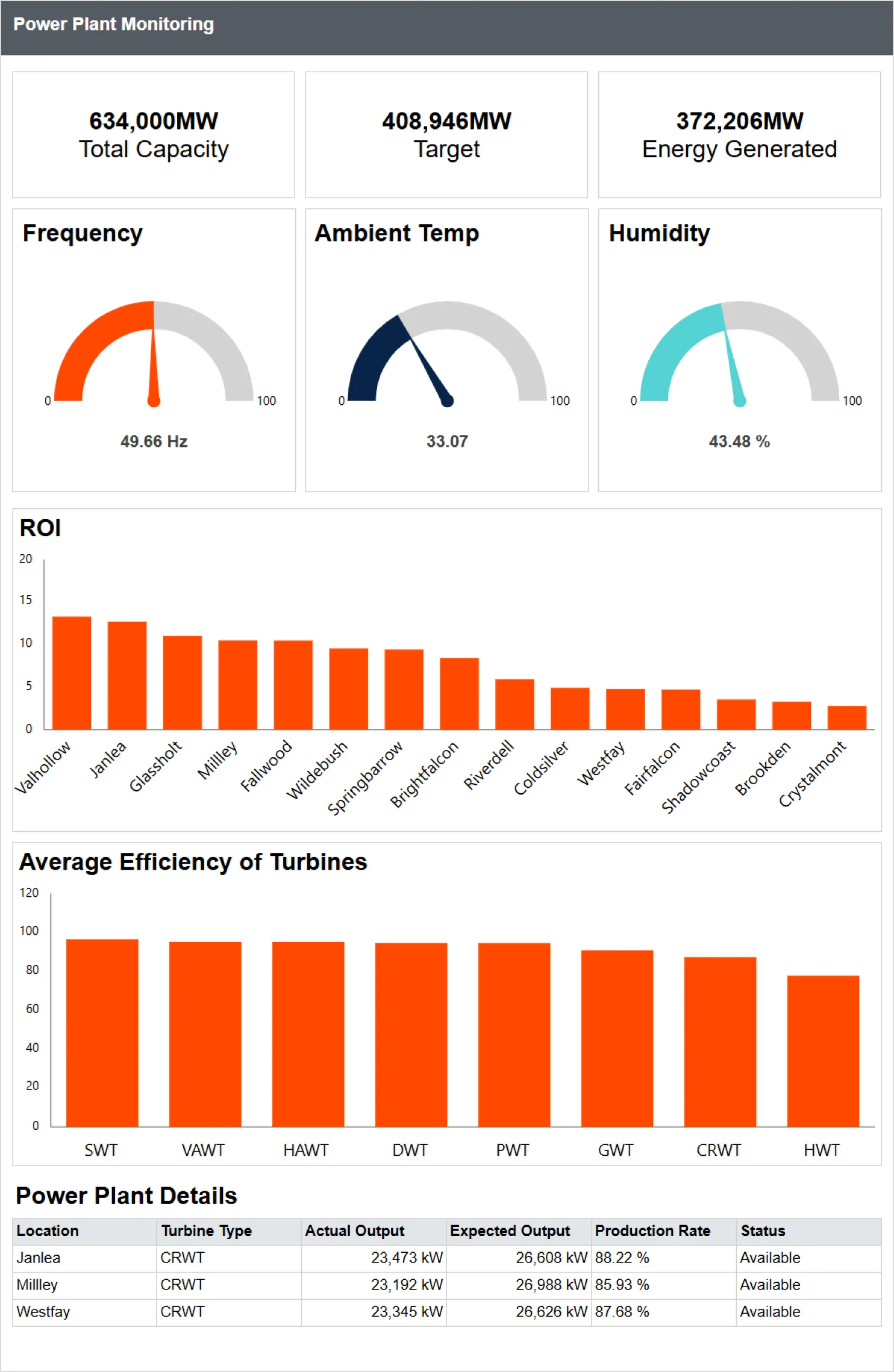
3. Energy
Energy providers operate across distributed systems to track production, consumption, and grid performance. Without unified reporting, gaining real-time insights into efficiency and compliance becomes challenging. With reporting integrated into energy management platforms:
-
- Operational visibility improves with real-time energy monitoring.
- Maintenance becomes proactive through anomaly detection.
- Compliance tracking simplifies with audit-ready reports.
This approach replaces static reporting with continuous monitoring and data-driven energy management.
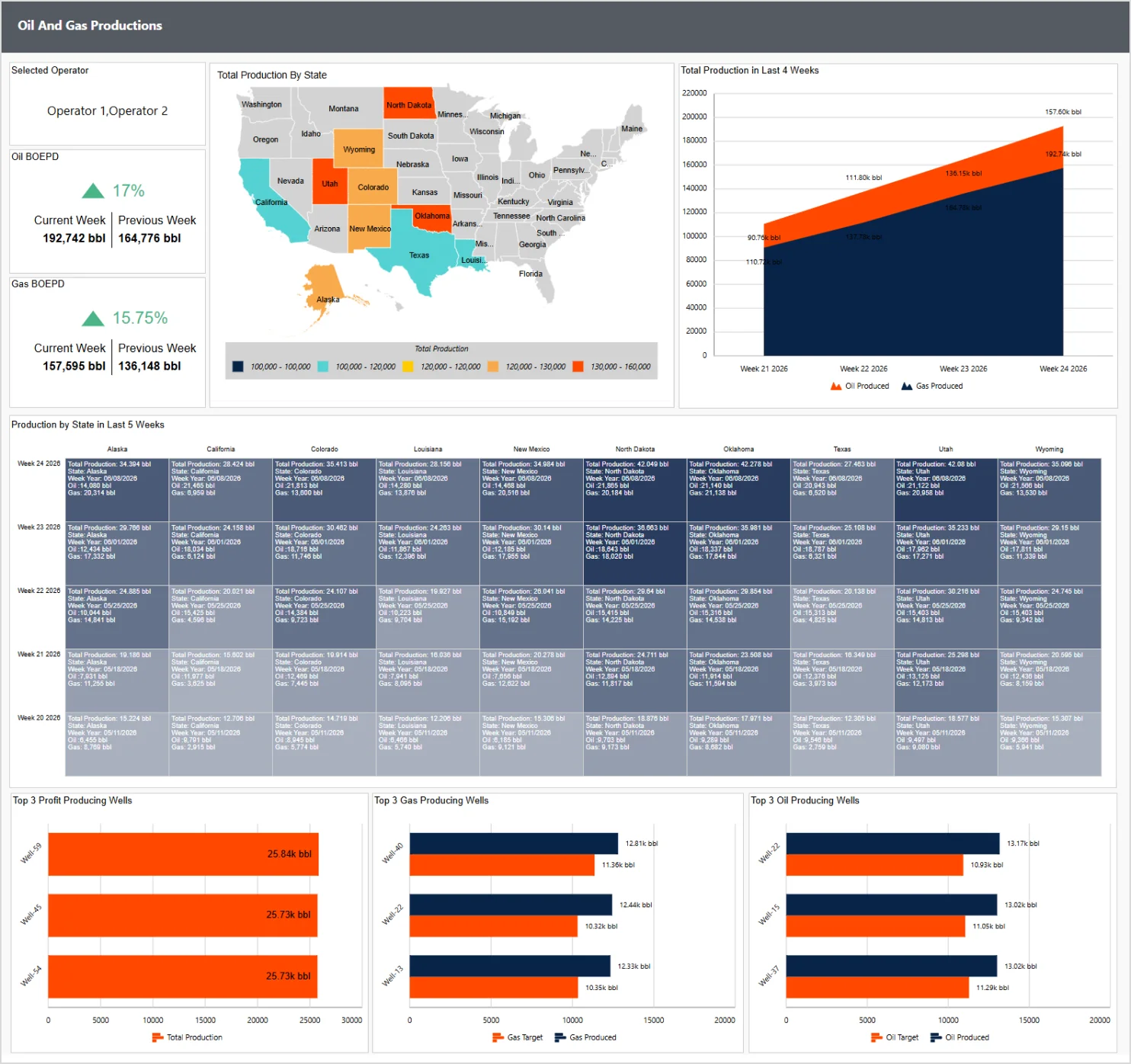
4. Oil and gas
Oil and gas operations generate vast amounts of data from exploration, drilling, and production systems, often stored across disconnected platforms. With reporting embedded into operational systems:
-
- Production performance is continuously tracked to improve efficiency.
- Safety oversight improves with real-time risk monitoring.
- Asset utilization increases with visibility into usage and maintenance.
Integrating reporting into workflows enables companies to move from lagging indicators to real-time operational control and risk management.
How Bold Reports helps SaaS teams deliver embedded reporting faster
Bold Reports enables SaaS companies to seamlessly embed powerful, real-time insights into their applications with minimal complexity. Built for modern SaaS needs, it delivers scalable, flexible and fully integrated in-app reporting that enhances user experience and drives engagement.
-
- Faster time-to-market with RDL compatibility: Leverage native RDL support to reuse and migrate existing SSRS reports without rebuilding, reducing development effort, and engineering costs while accelerating time to market.
- Seamless embedded reporting experience: Integrate embedded reporting into your SaaS application using developer-friendly APIs and SDKs, creating a unified user experience that boosts engagement and increases product adoption.
- Pixel-perfect report delivery: Ensure consistent, print-ready output across formats by delivering accurate, professional reports through PDFs, embedded views, and exports for reliable business reporting.
- Scalable and cost-efficient growth: Use a flexible licensing model tailored to your deployment requirements, providing the flexibility to scale as your SaaS business grows.
- Secure multi-tenant reporting: Support multitenant SaaS environments with enterprise-grade security, including data isolation and role-based access control, helping build trust and meet compliance requirements at scale.
Conclusion
In 2026, embedded reporting is no longer optional; it’s a competitive necessity for SaaS platforms. Users expect real-time, in-app insights as part of their daily workflows, and any gap between data and action leads to missed opportunities, lower engagement, and increased churn.
This shift is redefining how SaaS products compete. Platforms that embed reporting directly into the user’s experience don’t just improve usability; they become essential to how users operate and make decisions.
SaaS companies that delay adoption risk losing relevance, while those that invest now gain a clear edge in retention, revenue growth, and product differentiation. With Bold Reports, delivering embedded reporting at scale becomes faster and more efficient, turning reporting into a true competitive advantage.
Don’t fall behind in 2026; embed powerful reporting into your SaaS app now. Start a 30-day free trial or request a demo today to see Bold Reports in action.
Frequently asked questions
- 1.
How long does it take to implement embedded reporting in a SaaS product?
With a ready-made solution, implementation can take weeks, while building from scratch may take several months or longer.
- 2.
How does embedded reporting improve SaaS user experience?
It removes the need to switch tools, giving users instant access to insights within their workflow, which improves usability and efficiency.
- 3.
Does embedded reporting support compliance requirements?
Yes, features like role-based access, audit-friendly exports, and pixel-perfect reports help meet regulatory and compliance needs.
- 4.
How does embedded reporting improve product adoption?
By delivering insights directly within the workflow, users gain immediate value, increasing engagement, product usage, and overall retention.
- 5.
What is the difference between embedded reporting and dashboards?
Embedded reporting focuses on structured, export-ready reports, while dashboards provide interactive, real-time visual analytics.
- 6.
How does embedded reporting work?
It connects data sources to a reporting engine that generates reports directly within a SaaS application using embedded components.
- 7.
Can embedded reporting be monetized in SaaS products?
Yes, many SaaS companies offer advanced reporting features as premium add-ons or higher-tier plans.