What Is Enterprise Reporting? Benefits and Best Practices
TL;DR:
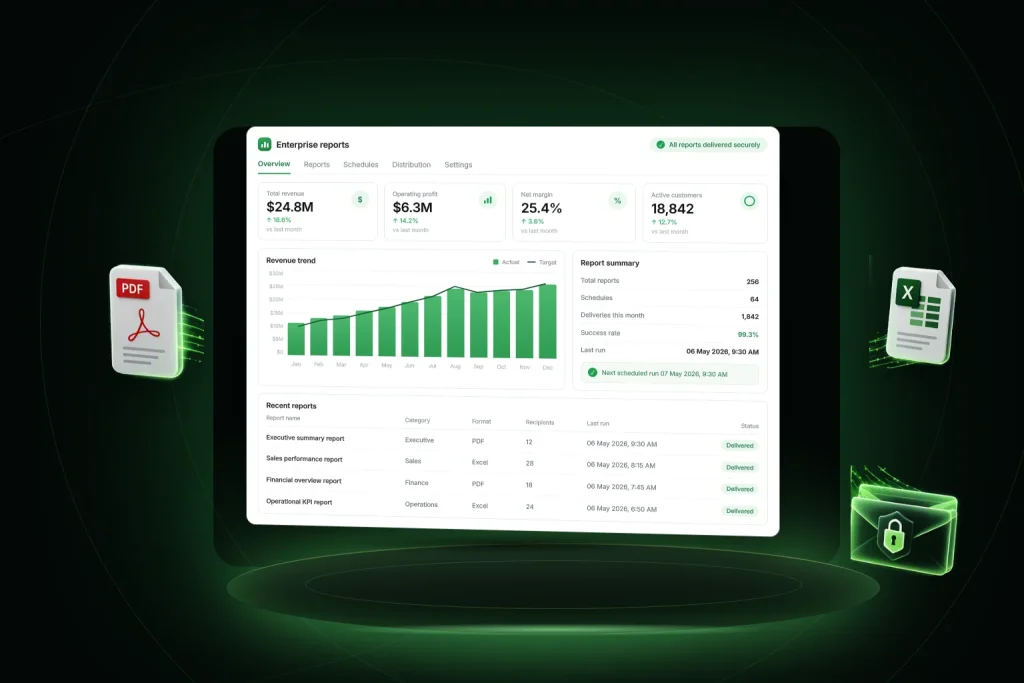
Enterprise reporting is the process of creating, managing, governing, and distributing standardized business reports at scale using trusted data sources, consistent report designs, and controlled delivery. It helps organizations centralize report operations, automate scheduling and report bursting, strengthen security and auditability, and deliver consistent output (PDF/Excel) to employees, executives, customers, partners, and regulators.
Introduction
If generating reports feels harder than it should, you’re not alone.
Many organizations start with a handful of reports shared across departments. As the business grows, so do reporting demands. Finance teams need monthly closing packages. Operations teams require standardized performance reports. Executives expect timely reporting packs they can trust. Customers want access to account summaries, billing statements, and usage reports.
Before long, reports are created from multiple systems, distributed manually, and maintained by different teams using different definitions and processes.
The problem isn’t a lack of data. The problem is managing reporting at scale.
As reporting requirements expand, organizations often run into predictable issues:
-
- Reports are scattered across departments and systems.
- Business users depend on IT for simple report changes.
- Manual report generation and distribution consume time.
- Security and compliance requirements become harder to enforce.
- Executives lose confidence when teams report different versions of the same metric.
Enterprise reporting addresses these issues with a centralized approach to creating, managing, and delivering reports so outputs stay consistent, secure, scalable, and auditable.
What is enterprise reporting?
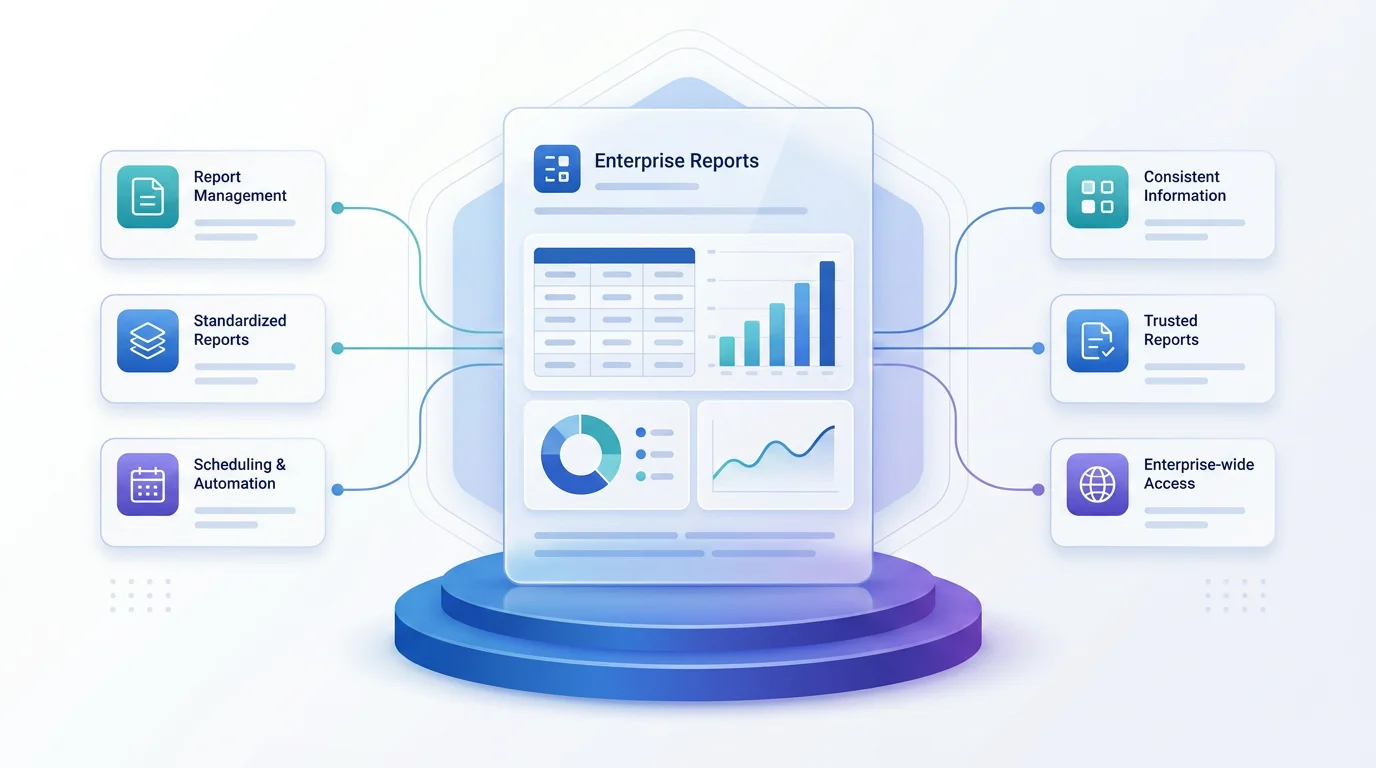
Enterprise reporting is the process of creating, managing, and distributing standardized reports across an organization using trusted data, consistent business rules, and governed reporting processes.
To put a cost lens on the impact of fragmented reporting and inconsistent data foundations, Gartner estimates that poor data quality costs organizations an average of $12.9 million per year, highlighting the significant business impact of disconnected reporting environments and unreliable information sources.
Unlike departmental reporting built for one team, enterprise reporting delivers consistent information across business units and stakeholders, often including external audiences such as customers, partners, auditors, or regulators.
A well-designed enterprise reporting strategy helps organizations:
-
- Standardize metrics, calculations, and report formats.
- Centralize report assets such as templates, datasets, schedules, and permissions.
- Automate generation and delivery through scheduling, subscriptions, and report bursting.
- Control access through role-based permissions and maintain auditability.
- Scale distribution without increasing manual workload.
For example, an organization can combine data from multiple business systems to generate standardized reports for executives, managers, and customers, ensuring everyone works from the same reliable information.
In short, enterprise reporting transforms fragmented business data into trusted insights that support better decision-making across the organization.
What makes enterprise reporting different?
Traditional reporting is often designed for a single team or function. Enterprise reporting manages the entire reporting lifecycle across departments, stakeholders, customers, and locations. The difference is not simply scale. It is how reporting is managed, governed, and distributed across the organization.
Here’s how departmental reporting compares with enterprise reporting:
-
- Enterprise reporting platform for centralized control: In departmental reporting, teams manage reports and data sources independently. Enterprise reporting centralizes reports, schedules, permissions, and data sources in a governed environment.
-
- Automated report delivery: Departmental reporting frequently relies on manual distribution, while enterprise reporting supports scheduling, subscriptions, export automation, and report bursting at scale.
-
- Role-based security and governance: Rather than applying different standards across teams, enterprise reporting enforces consistent access controls, governance policies, and auditability across the organization.
- Controlled self-service: Business users can run and customize approved reports without compromising enterprise reporting standards.
- Enterprise-scale distribution: While departmental reports are typically shared with a limited audience, enterprise reporting delivers information across business units, regions, customers, and partners.
- Customer-facing and embedded reporting: Unlike traditional departmental reporting that primarily serves internal users, enterprise reporting can securely deliver reports through customer portals, applications, and SaaS products.
For example, a SaaS provider can automatically generate customer-specific usage reports, deliver them securely through a portal, and scale reporting as its customer base grows, all without increasing manual reporting workloads.
Ultimately, enterprise reporting is not just about creating reports. It’s about managing, governing, and delivering trusted information efficiently at scale.
Why enterprise reporting matters in 2026
Enterprise reporting matters more in 2026 because reporting demands have intensified, not only in volume but also in operational complexity.
Common drivers include:
-
- Higher data volumes and a growing number of business systems contributing to the organization’s reporting environment
- Stronger compliance and governance expectations around access control, auditability, data privacy, and retention
- More stakeholders requiring timely access to consistent reports, including employees, executives, customers, partners, auditors, and regulators
- Increasing expectations for automated report delivery through scheduling, subscriptions, report bursting, and reliable PDF and Excel exports
- Growing demand for embedded and customer-facing reporting as a product and customer-experience requirement for many SaaS businesses
Enterprise reporting helps organizations keep reporting consistent, secure, and scalable as these demands continue to increase.
Why reporting becomes challenging as organizations grow
Reporting processes that work for a small team often can’t keep pace with a growing organization. As new departments, business systems, stakeholders, and reporting requirements are introduced, managing reports becomes significantly more complex.
What starts as a simple reporting process can quickly become a challenge involving fragmented data, inconsistent metrics, manual workflows, governance concerns, and growing demands for timely access to information.
Common challenges include:
-
- Data gets scattered across systems: CRM, ERP, finance applications, operational databases, and cloud services create fragmented data environments. Teams often spend significant time gathering and reconciling information before reporting can even begin.
- Reporting requests keep expanding: Executives, managers, compliance teams, customers, and partners all require different reports, delivery schedules, formats, and access levels.
- Manual processes become bottlenecks: Spreadsheets, shared drives, and manual report distribution may work initially, but they become difficult to scale and increase the risk of reporting errors.
- Dependence on IT slows delivery: When report creation and modifications require technical resources, reporting backlogs grow, and business users wait longer for the information they need.
- Distribution becomes operationally complex: Delivering reports to different audiences across locations, time zones, and delivery channels requires far more coordination than simply generating reports.
- Security and compliance requirements increase: As reporting audiences expand, organizations must maintain role-based access controls, audit trails, and governed access to sensitive information, particularly for customer-facing and compliance-related reporting.
These challenges often drive the adoption of enterprise reporting, providing centralized management, automation, governance, and scalability to support reporting at scale.
Key benefits of enterprise reporting
As reporting demands grow, organizations need more than a way to generate reports. They need a reporting framework that delivers accurate information, supports business growth, and reduces the operational burden of managing reports across multiple users, departments, and stakeholders.
Key benefits of enterprise reporting include:
-
- Higher confidence in numbers: Standardized KPIs, business rules, and report definitions help ensure stakeholders work from consistent information rather than conflicting metrics from different teams.
- Faster reporting cycles: Reusable report templates, centralized management, and automation reduce the time needed to prepare, generate, and distribute recurring reports.
- Lower manual workload: Features such as report scheduling, subscriptions, automated exports, and report bursting help eliminate repetitive reporting tasks and free teams to focus on analysis.
- Stronger governance and control: Centralized oversight of reports, permissions, and reporting processes helps organizations improve security, auditability, and compliance.
- Scalable report distribution: Reports can be delivered across departments, business units, customers, and partners without significantly increasing administrative effort.
- Better stakeholder experience: Consistent report formats, reliable delivery, and timely access to information help improve the reporting experience for employees, executives, customers, and other stakeholders.
Ultimately, enterprise reporting helps organizations move from fragmented and manual reporting processes to a more efficient, governed, and scalable reporting environment.
Key features to evaluate in enterprise reporting software
Not all enterprise reporting software provides the same level of functionality. When evaluating enterprise reporting tools, look beyond basic report generation and prioritize capabilities that support long-term scalability, administration, and enterprise-grade delivery.
Essential capabilities of enterprise reporting software include:
-
- Advanced report design: Support for pixel-perfect reports, pagination, reusable templates, and consistent exports across business-critical documents.
- Report scheduling and subscriptions: Automated report generation, recurring delivery schedules, and subscription management for large reporting audiences.
- Report bursting: Deliver personalized reports to departments, regions, business units, partners, or customers from a single report template.
- High-quality exports: Generate PDF, Excel, CSV, Word, and other export formats while preserving report structure and formatting.
- Embedded reporting capabilities: Integrate reports into internal applications, customer portals, and SaaS products without disrupting the user experience.
- Developer APIs and extensibility: Enable automation, integration, custom workflows, and application-level control through APIs and SDKs.
- Operational scalability: Handle increasing report volumes, concurrent users, large datasets, and growing reporting workloads efficiently.
Enterprise reporting use cases across industries
Enterprise reporting is used across industries to deliver consistent, accurate, and governed information to decision-makers, employees, customers, and external stakeholders. While reporting requirements vary by industry, the goal remains the same: provide trusted information in a standardized format and distribute it efficiently to the people who need it.
Common enterprise reporting use cases include:
-
- Sales: Monitor pipeline performance, quota attainment, regional sales trends, and revenue performance to help sales leaders track progress and identify growth opportunities.
- Marketing: Measure campaign performance, lead generation, conversion rates, and marketing ROI through standardized reports that support data-driven decision-making.
- Manufacturing: Track production output, equipment downtime, inventory levels, quality metrics, and supply chain performance to improve operational efficiency.
- Retail: Analyze store performance, inventory movement, customer purchasing behavior, and regional sales trends to support better merchandising and planning decisions.
- Financial services: Generate regulatory reports, risk assessments, financial performance reports, and audit-ready documentation to support compliance and governance requirements.
- Healthcare: Monitor operational performance, resource utilization, patient service metrics, and regulatory reporting requirements while maintaining reporting accuracy and accountability.
- SaaS and customer-facing reporting: Deliver usage reports, billing summaries, account health metrics, and customer-specific performance reports through portals, applications, and embedded reporting experiences.
Regardless of industry, enterprise reporting helps organizations standardize reporting processes, improve visibility, and deliver trusted information at scale.
How enterprise reporting works
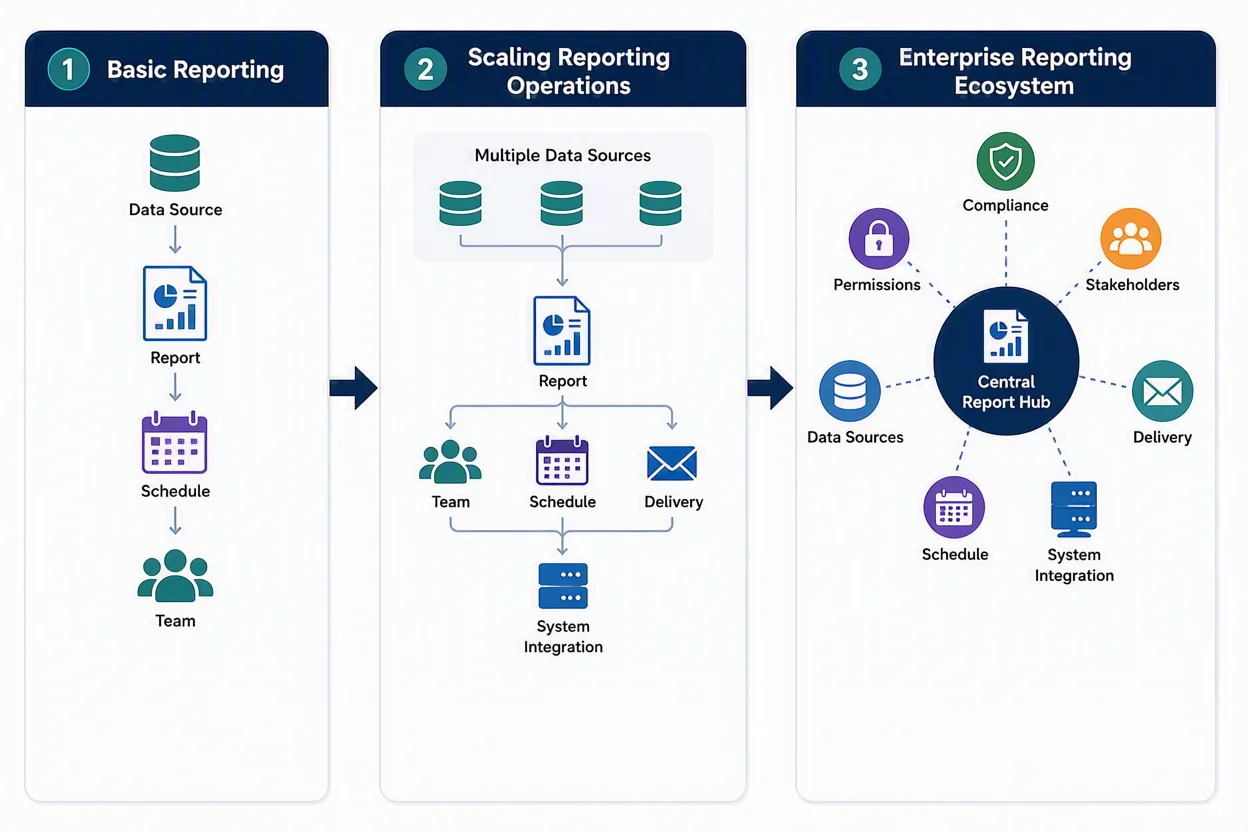
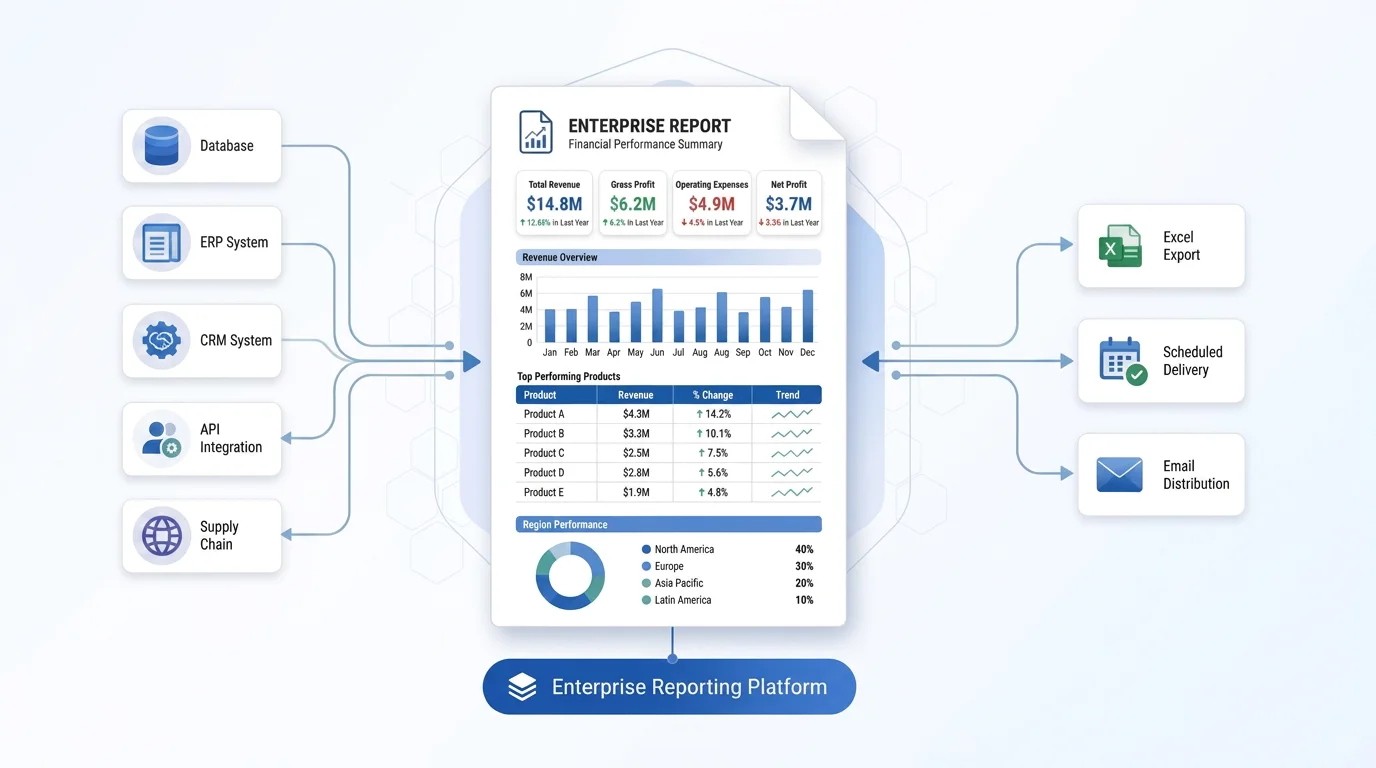
Enterprise reporting provides a structured framework for transforming business data into trusted reports that can be consistently managed, governed, and distributed across the organization. While implementations vary, most enterprise reporting processes follow four core stages.
1. Connect enterprise data
Enterprise reporting starts by integrating data from multiple business systems, including ERP platforms, CRM applications, databases, data warehouses, and cloud services. By connecting these data sources, organizations can reduce information silos and create a consistent foundation for reporting.
2. Create standardized reports
Reports are built using approved business definitions, shared KPIs, and standardized templates. This ensures reporting remains consistent across departments and stakeholders while reducing duplicate report development.
3. Govern and manage reporting operations
Enterprise reporting requires centralized oversight of reports, users, permissions, schedules, and reporting assets. Strong governance helps organizations maintain reporting consistency, support compliance requirements, and control access to sensitive information.
4. Deliver information at scale
Reports are distributed through scheduled delivery, subscriptions, report portals, embedded applications, and automated exports. This enables organizations to provide timely access to information while reducing the operational burden of manual report distribution.
Together, these four stages create a scalable reporting framework that helps organizations transform data into trusted information and deliver it efficiently across teams, stakeholders, customers, and business units.
Types of enterprise reports
Not all enterprise reports serve the same purpose. Some are designed for regulatory compliance and formal distribution, while others support operational monitoring, automated delivery, or personalized reporting. Understanding different report types helps organizations choose the right reporting approach for different business needs.
- Pixel-perfect reports: Designed for highly formatted, print-ready documents where layout consistency is critical. These reports are commonly used for financial statements, invoices, regulatory reports, board reports, and customer statements.
- Parameterized reports: Allow users to filter reports using predefined parameters such as date range, region, department, product, or customer. This reduces the need to create and maintain multiple versions of the same report.
- Scheduled reports: Automatically generate and deliver reports on a recurring schedule, such as daily, weekly, or monthly. These reports help ensure stakeholders receive information consistently without manual effort.
- Report bursting: Generates personalized report outputs from a single report template and distributes them to specific recipients. Common examples include customer-specific statements, territory-based sales reports, and department-level performance reports.
- Exception reports: Highlight anomalies, thresholds, or business events that require attention. Examples include inventory shortages, SLA breaches, compliance violations, unusual transactions, or performance issues.
Together, these report types help organizations support operational, regulatory, executive, and customer-facing reporting while maintaining consistency and scalability across the enterprise.
The 7 requirements of enterprise reporting
Enterprise reporting requires more than the ability to create reports. To support reporting across departments, business units, customers, and stakeholders, organizations need a reporting environment that can maintain consistency, governance, and scalability. The following requirements form the foundation of effective enterprise reporting.
-
- Centralized report management: Manage reports, datasets, schedules, users, and permissions from a single governed environment to improve consistency and simplify administration.
- Self-service reporting: Enable business users to access, customize, and generate reports independently while maintaining centralized governance and reporting standards.
- Pixel-perfect reporting: Preserve report layouts and formatting across PDF, Excel, print, and other export formats, ensuring professional and compliant business documents.
- Automated report distribution: Support scheduling, subscriptions, report bursting, and export automation to reduce manual effort and ensure timely report delivery.
- Enterprise security and governance: Enforce role-based access, audit trails, approval processes, and controlled publishing to protect sensitive information and support compliance.
- Flexible data connectivity: Connect to databases, data warehouses, ERP systems, CRM platforms, cloud applications, and APIs without creating additional data silos.
- Flexible deployment options: Support on-premises, cloud, hybrid, embedded, and customer-facing deployments to align with organizational security, compliance, and infrastructure requirements.
These capabilities help organizations build a reporting environment that remains accurate, governed, and scalable as reporting requirements continue to grow.
Common enterprise reporting challenges
As reporting environments grow, organizations often struggle to maintain consistency, governance, and efficiency across reports, users, and data sources. The following challenges commonly emerge when reporting processes are not centralized or standardized.
-
- Inconsistent reporting standards: Conflicting KPI definitions, calculations, and report formats can lead to different teams reporting different versions of the same metric.
- Disconnected reporting tools: Data spread across multiple reporting systems, spreadsheets, and business applications increases reconciliation effort and reporting complexity.
- Report sprawl: Duplicate reports, outdated versions, and unclear ownership make reporting environments difficult to manage and govern.
- Reporting backlogs: Heavy dependence on IT teams for report creation, updates, and maintenance can slow access to information.
- Manual report distribution: As reporting audiences grow, exporting, sharing, and delivering reports manually becomes increasingly inefficient and error-prone.
- Governance and compliance gaps: Inconsistent permissions, limited auditability, and weak reporting controls can increase security and compliance risks.
- Customer-facing reporting at scale: Delivering personalized reports while maintaining branding, data isolation, security, and performance introduces additional operational challenges.
Addressing these challenges requires a centralized reporting approach that combines governance, automation, standardization, and scalable report delivery.
Common enterprise reporting mistakes to avoid
Even organizations that invest in enterprise reporting can struggle if they manage reporting processes poorly. Avoiding the following mistakes can help maintain reporting consistency, governance, and long-term scalability.
-
- Treating reporting as one-off requests: Manage reporting as a governed program with standardized processes, ownership, and reporting standards.
- Duplicating reports unnecessarily: Use shared datasets, reusable templates, and parameters instead of maintaining multiple versions of the same report.
- Skipping export validation: Verify PDF, Excel, and other exports regularly, especially for reports used in audits, compliance reviews, and executive reporting.
- Underestimating distribution complexity: Consider scheduling, subscriptions, report bursting, delivery monitoring, retries, and time-zone requirements as reporting volumes grow.
- Over-permissioning user access: Apply role-based access controls to reduce security risks and limit the exposure of sensitive information.
- Failing to retire outdated reports: Periodically review reporting assets to remove obsolete reports, reduce maintenance effort, and prevent report sprawl.
Avoiding these common mistakes helps organizations maintain a reporting environment that remains accurate, manageable, and scalable as reporting requirements evolve.
Enterprise reporting best practices
Successful enterprise reporting requires consistent standards, strong governance, and efficient reporting operations.
-
- Standardize KPI definitions: Use documented metrics and calculation rules across all reports.
- Establish governance: Define ownership, publishing standards, and approval workflows.
- Reduce report sprawl: Audit reporting catalogs regularly and retire unused reports.
- Automate recurring tasks: Schedule report generation, distribution, exports, and bursting.
- Enable controlled self-service: Allow access to approved reports and predefined filters.
- Monitor usage and delivery: Track adoption, failures, and report performance to improve reliability.
Following these practices helps organizations maintain reporting consistency, improve governance, and scale reporting more efficiently.
How to choose an enterprise reporting platform
Not all enterprise reporting solutions are designed for enterprise-scale reporting. Use the following checklist when evaluating platforms:
-
- Centralized management: Can reports, users, schedules, and permissions be managed from one place?
- Pixel-perfect reporting: Can it generate professional PDF, Excel, and print-ready reports without formatting issues?
- Automated delivery: Does it support scheduling, subscriptions, report bursting, and automated exports?
- Data connectivity: Can it connect to your databases, data warehouses, ERP systems, CRM platforms, cloud applications, and APIs?
- Embedded reporting: Can reports be delivered securely through customer portals, web applications, and SaaS products?
- Enterprise security: Does it provide role-based access, audit trails, authentication, and governance controls?
- Scalability: Can it handle growing numbers of users, reports, data sources, and delivery workloads?
The right enterprise reporting platform should help centralize reporting, automate distribution, maintain governance, and support growth without adding complexity.
How Bold Reports supports enterprise reporting at scale
Bold Reports® helps organizations centralize reporting operations, automate report delivery, and maintain governance across departments, business units, and customer-facing applications.
-
- Centralized report management: Manage reports, datasets, schedules, users, and permissions from a single reporting platform.
- Automated report distribution: Schedule reports, configure subscriptions, automate exports, and streamline report delivery.
- Controlled self-service reporting: Empower business users to access and create reports while maintaining governance and reporting standards.
- Flexible data connectivity: Connect to databases, cloud applications, APIs, ERP systems, CRM platforms, and other enterprise data sources.
- Embedded and customer-facing reporting: Deliver reports within customer portals, web applications, and SaaS products.
- Enterprise governance and scalability: Support role-based access, auditability, centralized administration, and large-scale reporting operations.
With centralized management, automated delivery, flexible connectivity, and enterprise-grade governance, Bold Reports helps organizations build a scalable enterprise reporting environment on a single platform.
Customer example: In a verified 2026 G2 review, Jonathan K., Senior Clinical PreSales Consultant, said, “The ability to embed reports directly into our application has significantly improved the user experience for our customers.” This highlights how embedded reporting helps organizations deliver reports directly within customer-facing applications, rather than requiring users to switch between systems.
Final thoughts
Understanding enterprise reporting is essential for organizations that need to deliver accurate, consistent, and trusted information at scale. From improving reporting consistency and governance to supporting automated distribution and customer-facing reporting, enterprise reporting helps businesses transform data into actionable insights that drive better decisions.
As reporting requirements grow, relying on disconnected tools, manual processes, and fragmented reporting environments becomes increasingly difficult. Organizations need a centralized reporting framework that connects multiple data sources, standardizes reporting processes, and supports secure report delivery across departments, stakeholders, and customers. Platforms like Bold Reports help by combining centralized report management, pixel-perfect reporting, automated distribution, embedded reporting, and enterprise-grade governance in a single solution.
By aligning the right reporting strategy with the right platform, organizations can reduce reporting complexity, improve operational efficiency, and scale reporting with confidence. If you’re looking to modernize your reporting environment, explore Bold Reports with a 30-day free trial or request a personalized demo to take the next step toward a more centralized, scalable enterprise reporting strategy.
Frequently asked questions
-
- 1.
How many reports can an enterprise reporting platform typically manage?
The number varies by platform, but enterprise reporting solutions are designed to support large reporting environments with hundreds or even thousands of reports, users, schedules, and data sources while maintaining centralized management and governance.
- 2.
Why do organizations struggle to scale reporting?
Reporting often becomes difficult to scale when reports are spread across departments, business users depend on IT for every request, and distribution relies on manual processes. As reporting demand grows, these challenges can lead to delays, inconsistencies, and governance issues.
- 3.
What types of users benefit from enterprise reporting?
Enterprise reporting supports a wide range of users, including executives, finance teams, operations managers, compliance teams, business analysts, customers, partners, and other stakeholders who rely on consistent access to business information.
- 4.
Can enterprise reporting support both internal and customer-facing reporting?
Yes. Many organizations use enterprise reporting for internal operational and executive reporting while also delivering reports to customers, partners, and external stakeholders through portals, applications, and self-service environments.
- 5.
What makes enterprise reporting difficult to govern?
Governance becomes challenging when reports are managed across multiple tools, departments, and teams. Common issues include inconsistent KPI definitions, duplicate reports, unclear ownership, unmanaged permissions, and limited visibility into report usage.
- 6.
What is the first step to improving enterprise reporting?
Start by centralizing reporting assets and establishing common reporting standards. Defining shared KPIs, report ownership, and governance processes creates a foundation that makes reporting easier to manage as the organization grows.
- 7.
How is enterprise reporting different from BI dashboards?
BI dashboards are usually interactive and designed for exploration and monitoring. Enterprise reporting focuses on standardized, governed, and repeatable output, often with pixel-perfect formatting, scheduled delivery, report bursting, and audit-ready controls for internal and external stakeholders.
- 1.