Embedded Reporting in Healthcare: Benefits and Use Cases

TL;DR
Embedded reporting in healthcare integrates real-time reports into EHR/EMR systems, patient portals, telehealth platforms, and healthcare applications. It helps providers eliminate data silos, improve clinical and operational reporting, support HIPAA compliance, track healthcare KPIs, and make faster data-driven decisions, all within the workflows they use every day. Bold Reports® delivers secure, scalable embedded reporting for modern healthcare organizations.
Introduction
Embedded reporting in healthcare is transforming how healthcare organizations access and analyze data by delivering real-time healthcare reports within EHR systems, hospital management platforms, patient portals, and telehealth applications. Every patient’s interaction creates valuable data, yet many organizations still struggle to turn that data into timely, actionable insights.
According to the Healthcare Analytics Market Size & Share Report, 2026-2033, the global healthcare analytics market was valued at USD 65.6 billion in 2025 and is projected to reach USD 198.8 billion by 2033. This growth is being driven by increased adoption of EHRs, digital health technologies, remote patient monitoring, and data-driven healthcare systems, highlighting the growing need for healthcare analytics, integrated reporting, and real-time access to healthcare information.
The impact can be significant. Delayed access to clinical and operational information can slow diagnoses, increase patient wait times, complicate regulatory reporting, and reduce operational efficiency. At the same time, rising patient expectations and value-based care models are driving demand for faster, more accurate reporting.
Embedded reporting in healthcare addresses these challenges by integrating reports directly into the clinical and administrative applications healthcare teams already use. Instead of relying on separate reporting tools, organizations can access real-time insights within existing workflows. This guide explores what embedded reporting is, the reporting challenges it solves, key healthcare KPIs to track, and how Bold Reports® helps healthcare providers and software vendors deliver secure, scalable, HIPAA-aware reporting.
What is embedded reporting in healthcare
Embedded reporting in healthcare integrates reporting directly into the applications healthcare organizations use every day, including EHR/EMR systems, hospital management software, patient portals, telehealth platforms, and payer applications. Instead of switching to a separate reporting tool, users can access reports within their existing workflows.
For example, physicians can review treatment outcomes inside the EHR, nurse managers can track patient wait times in hospital management systems, and billing teams can analyze claims data without leaving revenue cycle applications.
This approach is especially valuable because:
-
- Healthcare workflows are time sensitive. Reducing application switching helps clinicians and staff work more efficiently.
- Patient data requires strong protection. Keeping reports within existing systems helps support HIPAA compliance and reduces unnecessary data movement.
- Decisions depend on real-time insights. Teams need up-to-date information on areas such as bed occupancy, staffing, inventory, and patient flow.
By embedding reports directly into clinical and administrative applications, healthcare organizations can improve workflow efficiency, access unified reporting across departments, and make faster decisions.
How embedded reporting works in healthcare
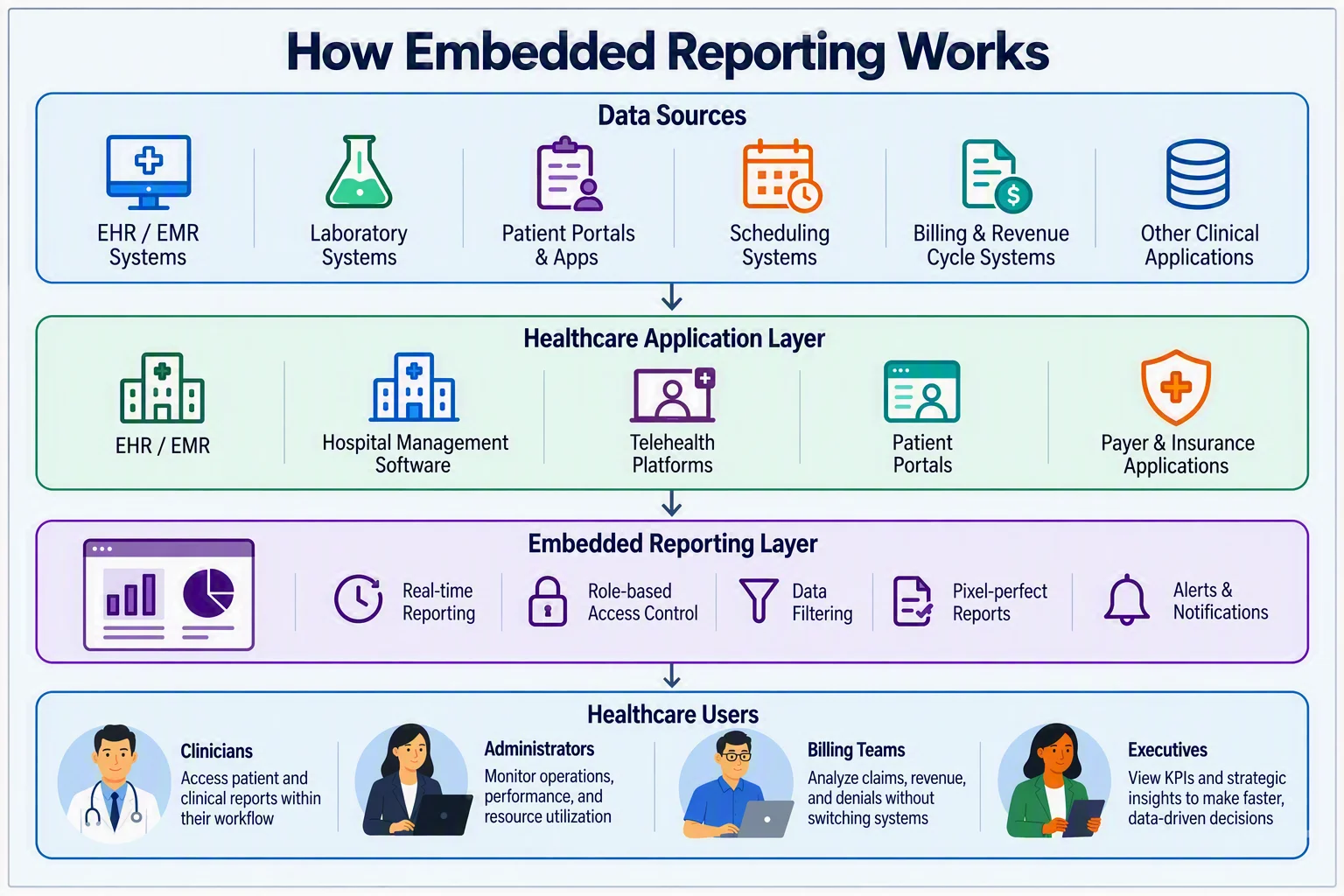
Embedded reporting in healthcare integrates data from EHR/EMR systems, patient portals, billing platforms, and other healthcare applications into a centralized reporting layer. This enables clinicians, administrators, and billing teams to access real-time healthcare reports directly within their existing workflows, eliminating the need to switch between systems.
Common healthcare reporting challenges
Healthcare organizations operate in a complex environment where data is abundant but often difficult to manage, unify, and report on effectively. The most common healthcare reporting challenges include:
- Fragmented, siloed data. Clinical, financial, and operational data typically lives across separate systems such as EHR/EMR, lab systems, imaging tools, billing platforms, and scheduling software each with its own format and access model. Without integration, no single view of a patient or department exists.
- Delayed reporting. Collecting, validating, and consolidating data manually (or via periodic exports) introduces lag between when an event happens and when it’s reflected in a report, hindering timely clinical and operational decisions.
- Patient data privacy and compliance risk. Ensuring compliance with HIPAA and other healthcare data regulations is critical. Every additional system a report passes through, whether spreadsheets, email attachments, or third-party reporting tools, creates another potential point of exposure.
- Clinical data complexity. Healthcare data arrives in varied formats from multiple sources (lab systems, imaging tools, wearables, telehealth platforms), making standardized categorization and analysis difficult without a consistent reporting layer.
- Duplicate or missing records. Inconsistent patient record management across systems can produce duplicate entries or missing information, directly impacting care quality, patient analysis reporting accuracy, and billing.
- Disconnected clinical systems. Combining data from disparate systems, e.g. pharmacy, billing, scheduling, telehealth into one coherent report is often complex, manual, and time-consuming without embedded integration.
- Patients wait times and resource bottlenecks. Long wait times for consultations, treatments, or test results often trace back to inefficient data flow. When clinical and operational data isn’t readily accessible, scheduling and resource allocation become reactive rather than proactive.
How embedded reporting solves these challenges: Core benefits
Embedded reporting offers a practical approach to healthcare data management by integrating reporting directly into clinical and administrative workflows. Here are five core benefits:
- Real-time visibility into patient data. Embedded reporting provides instant access to up-to-date clinical and operational data, helping healthcare teams monitor patient records, treatments, and billing without delays, directly addressing reporting delays.
- Accuracy and standardization. Embedded reporting automates data validation to reduce manual-entry errors and enforce uniform formats across reports, ensuring reliable, consistent, and clear communication across departments, helping overcome data fragmentation.
- Compliance and governance. Embedded reporting strengthens compliance by maintaining detailed audit trails for patient care and billing activity while helping reports adhere to standards like HIPAA. Built-in rules and access checks simplify regulatory audits and safeguard data integrity, reducing compliance risks.
- Better decision-making through healthcare reports. Embedded reporting helps healthcare teams analyze treatment outcomes, resource utilization, and cost patterns, turning healthcare KPI reporting and patient analysis reporting into an everyday workflow tool rather than a quarterly export exercise.
- Smooth integration with healthcare systems. Embedded reporting tools integrate directly into hospital management systems, EHR/EMR platforms, and patient portals, eliminating the need to switch between platforms or export data for analysis.
Choosing the right healthcare embedded reporting solution requires easy integration, HIPAA compliance, scalability, and ease of use to deliver actionable insights across healthcare workflows.
Use cases across the healthcare ecosystem
Embedded reporting in healthcare delivers value across different types of healthcare organizations by providing reports within the applications users rely on every day.
1. Hospitals and health systems
Hospitals and health systems use embedded reporting to consolidate data from EHR/EMR systems, billing platforms, and clinical applications into centralized reports. Common use cases include bed occupancy reporting, patient flow analysis, staffing reports, and healthcare resource utilization tracking.
2. Clinics and outpatient practices
Clinics use embedded reporting to monitor appointment scheduling, patient no-show rates, treatment outcomes, revenue cycle performance, and claims reporting directly within practice management and EHR systems.
3. Healthcare providers and clinicians
Physicians, nurses, and care teams use real-time patient reports, treatment outcome reports, care plan tracking, and patient wait-time reports within their clinical workflows, enabling faster and more informed decisions.
4. Insurers and payers
Health insurers use embedded reporting to analyze claims data, provider performance, healthcare utilization trends, fraud detection metrics, and compliance reports within payer and member management platforms.
5. Healthcare software vendors
Healthcare software vendors embed white-label reporting and healthcare reports into EHR/EMR systems, telehealth platforms, patient portals, and healthcare SaaS applications, enabling customers to access self-service healthcare reports without leaving the application.
Real-world embedded reporting success story
Embedded reporting is not only reshaping healthcare but also helping software vendors modernize reporting experiences across industries. For example, a U.S.-based SaaS company in the renewable energy sector replaced legacy SSRS and ASP.NET Web Forms reporting with embedded self-service reporting powered by Bold Reports. By integrating reporting directly into its application, the company enabled users to create, access, and manage reports without leaving the platform while maintaining row-level security.
While the following example comes from the energy sector, it demonstrates how embedded reporting can improve user workflows, security, and self-service reporting capabilities across highly regulated industries, including healthcare.
Healthcare reporting KPIs to track
Healthcare KPI reporting helps healthcare organizations convert clinical and operational data into actionable insights. The following KPIs are commonly used to measure clinical outcomes, operational efficiency, patient experience, and financial performance.
| Healthcare KPI | What it measures | Business value |
| Patient wait times | Time between check-in, consultation, diagnosis, and treatment | Helps identify bottlenecks, optimize scheduling, and improve patient experience |
| Patient satisfaction scores | Feedback from patient surveys on care quality, communication, and overall experience | Helps improve service quality, patient engagement, and retention |
| Readmission rates | Percentage of patients readmitted within a defined period after discharge | Helps evaluate care quality, discharge planning, and follow-up effectiveness. Organizations participating in value-based care programs often monitor metrics associated with HEDIS, MIPS, readmission rates, and patient satisfaction |
| Bed occupancy and capacity utilization | Percentage of occupied beds and resource usage levels | Helps manage capacity, prepare for demand fluctuations, and improve patient flow |
| Treatment outcomes | Recovery rates, complication rates, mortality rates, and average length of stay | Supports evaluation of treatment effectiveness and clinical performance |
| Staff and resource utilization | Clinician workloads, nurse-to-patient ratios, shift coverage, and equipment usage | Helps improve operational efficiency, reduce burnout, and maintain care quality |
| Revenue cycle performance | Claims processing times, denial rates, reimbursement rates, and accounts receivable | Helps improve cash flow, billing efficiency, and financial performance |
Modern healthcare trends shaping reporting needs
The growth of digital healthcare infrastructure continues to increase reporting demands. According to the Office of the National Coordinator for Health Information Technology (ONC), more than 99% of non-federal acute care hospitals and 91% of office-based physicians had adopted certified EHR systems by 2024. As healthcare organizations manage increasing volumes of clinical, operational, and patient data, the need for embedded reporting in healthcare, healthcare KPI reporting, and real-time healthcare reports continues to grow, enabling stakeholders to access insights directly within existing workflows.
Several healthcare trends are accelerating the need for embedded reporting and real-time healthcare reporting:
-
- Telehealth and virtual care: As telehealth becomes a core part of care delivery, healthcare organizations need reporting that combines virtual and in-person patient data for a complete view of performance and outcomes.
- Patient engagement and self-service portals: Patients increasingly expect access to medical records, appointment history, and billing information through patient portals, expanding the need for embedded reporting in patient-facing applications.
- Real-time healthcare reporting: Organizations are moving away from batch reporting and adopting real-time reports that support faster clinical and operational decision-making.
- Value-based care and outcome-based reimbursement: Metrics such as readmission rates, treatment outcomes, and patient satisfaction scores are becoming critical for both care quality and financial performance.
- AI adoption in healthcare: Healthcare organizations are increasingly exploring AI technologies to support forecasting, operational planning, and clinical decision-making. As these initiatives mature, reporting systems must be able to present the resulting information in a clear and accessible format.
- Multitenant reporting for healthcare SaaS platforms: Healthcare software vendors increasingly require secure, white-label embedded reporting that supports multiple healthcare organizations within a single platform.
Best practices for implementing embedded reporting in healthcare
To successfully implement embedded reporting in healthcare, consider the following best practices:
- Prioritize easy integration: Choose a solution that integrates easily with EHR/EMR systems, hospital management software, patient portals, and other healthcare applications through modern APIs and embedded components.
- Enable self-service reporting: Look for intuitive reporting tools that allow clinicians, administrators, and operational teams to access insights without relying heavily on IT resources.
- Ensure security and compliance: Select a platform with encryption, role-based access control, audit trails, and features that support healthcare regulatory requirements and patient data protection.
- Plan for scalability and customization: The solution should support evolving reporting needs, whether for a single clinic, a large health system, or a multitenant healthcare SaaS platform.
- Choose flexible deployment options: Support for both cloud and on-premises deployment helps organizations align reporting infrastructure with their operational and compliance requirements.
- Evaluate support and documentation: Comprehensive documentation and reliable technical support help accelerate implementation, simplify maintenance, and ensure long-term success.
Build vs. buy embedded reporting for healthcare
Healthcare organizations and software vendors often evaluate whether to build or buy embedded reporting solutions when modernizing their reporting infrastructure.
| Factor | Build in-house | Buy an embedded reporting platform |
| Deployment time | Months or years of development and testing | Faster implementation with ready-to-use features |
| Development effort | Requires dedicated engineering resources | Minimal development required for integration |
| Security and compliance | Must be designed, implemented, and maintained internally | Built-in security features and compliance support |
| Reporting capabilities | Developed from scratch over time | Production-ready reporting, exporting, and scheduling features |
| Maintenance and updates | Continuous internal responsibility | Vendor-managed enhancements and updates |
| Self-service reporting | Requires significant custom development | Available out of the box |
| Total cost of ownership | Can increase significantly over time | More predictable and often lower long-term costs |
Why is Bold Reports the best embedded reporting platform for your healthcare organization?
Bold Reports® is an ideal embedded reporting solution for healthcare organizations looking to centralize healthcare data, streamline reporting workflows, improve visibility, and enhance patient outcomes. With a unified reporting platform, organizations can monitor clinical, financial, and operational KPIs to support faster, data-driven decisions.
Key capabilities include:
- Embedded reporting for easy access: Healthcare professionals can access critical insights without leaving their workflow. Embedded reporting integrates custom or pre-built clinical and operational reports directly into EHR/EMR systems, hospital management platforms, and telehealth applications, eliminating context-switching and accelerating decision-making.
- Real-time collaboration for faster decisions: Embedded reporting enables healthcare teams to collaborate on reports in real time, allowing instant sharing of patient data, synchronized updates, and faster consensus essential for improving care coordination and treatment planning.
- Enterprise-grade security for healthcare data: Patient data demands the highest level of protection. Embedded reporting supports compliance with healthcare regulations and provides encryption, role-based access, and secure authentication to keep sensitive information safe.
- White-label reporting for brand consistency: Healthcare organizations and healthcare software vendors can deliver fully branded reports that reflect their identity. Embedded reporting supports full customization, enabling professional presentation without building reporting tools from scratch.
- Flexible deployment to fit healthcare operations: Whether hosted on-premises for regulatory compliance or in the cloud for scalability, embedded reporting adapts to healthcare infrastructure, ensuring efficient reporting across diverse environments.
- Multitenancy for scalable healthcare management: For large hospital networks, multi-location clinics, or healthcare SaaS platforms serving many customer organizations, embedded reporting supports multitenant architecture, enabling centralized control and secure isolation of patient data across departments or tenants without sacrificing performance.
- Pixel-perfect reporting for professional output: Layout accuracy matters in healthcare. Embedded reporting delivers pixel-perfect reports tailored for screen and print, ensuring patient summaries, compliance documents, and regulatory reports meet professional standards.
- Rich data visualizations for clinical clarity: Embedded reporting helps healthcare teams turn complex clinical and operational data into clear, interactive visualizations. From treatment trends to resource utilization, these visualizations make it easier to interpret outcomes and communicate findings effectively.
Bold Reports healthcare report example
Patient experience analysis report
Due to frequent struggles with fragmented data, limited visibility into patient satisfaction, operational delays, and inefficient resource allocation, healthcare organizations often face challenges delivering high-quality care. The patient experience analysis report addresses these issues by enabling healthcare providers to monitor and evaluate patient satisfaction and operational efficiency across different hospital departments.
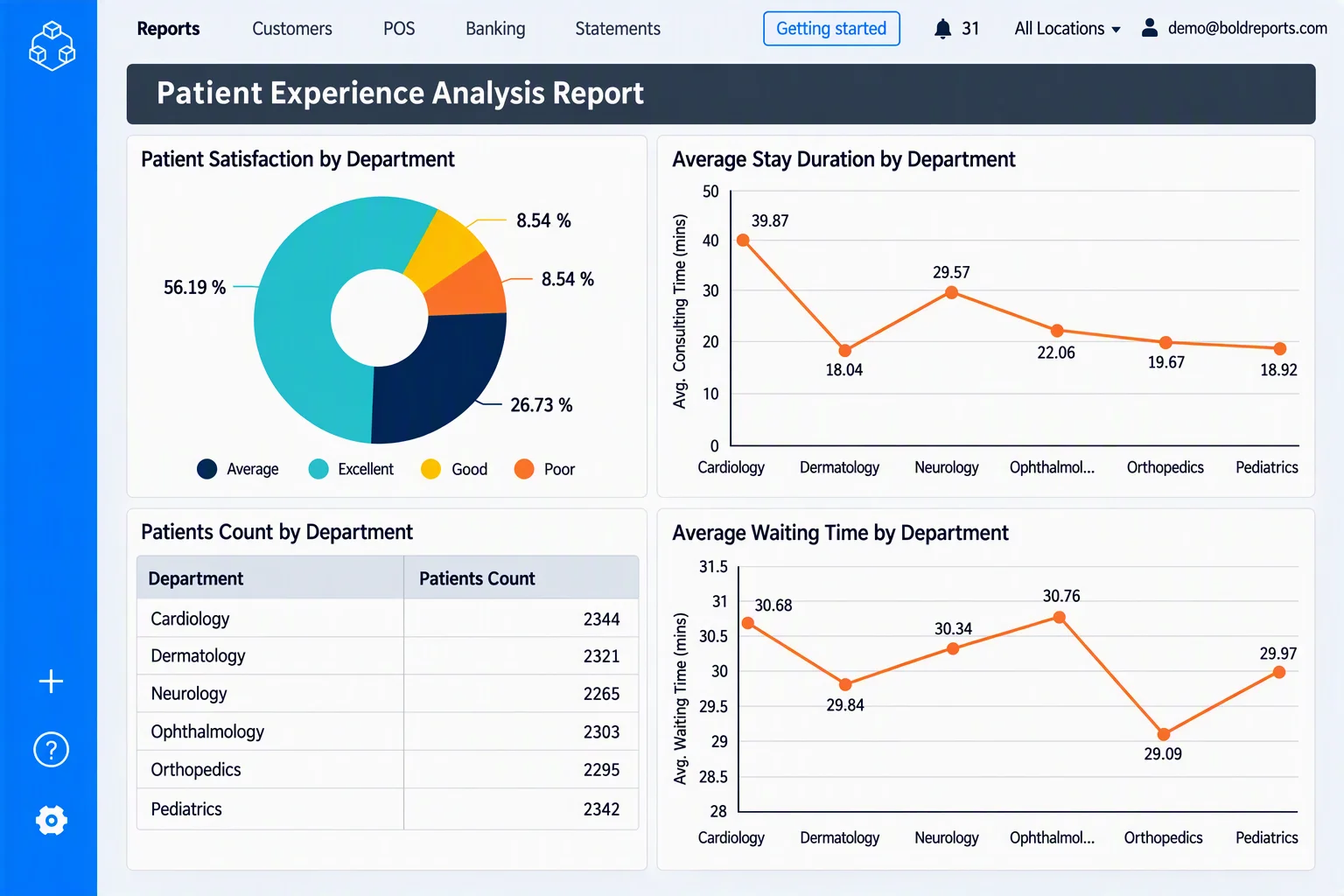
This report consolidates feedback, wait times, treatment outcomes, and resource usage into a single report, helping administrators identify bottlenecks, improve service delivery, and enhance overall patient experience, a practical example of both patient analysis reporting and healthcare KPI reporting working together in one embedded view. To explore the key metrics and KPIs used in this healthcare report example, refer to our live demo.
Final thoughts
Embedded reporting is transforming healthcare by unifying fragmented data, simplifying compliance, and enabling real-time insight, all within the applications clinicians and administrators use every day. Whether you’re a hospital consolidating cross-department data, a clinic streamlining day-to-day operations, a provider making point-of-care decisions, an insurer analyzing claims trends, or a healthcare software vendor building reporting into your own platform, embedded reporting turns healthcare reports and KPIs from a delayed, disconnected exercise into a continuous, in-workflow capability.
By integrating reports directly into clinical and administrative workflows, healthcare organizations can reduce manual effort, strengthen regulatory compliance, and deliver better patient outcomes.
Ready to modernize your reporting strategy? Bold Reports® offers a secure, scalable embedded reporting solution tailored for healthcare. Start your journey today, sign up for a free 30-day trial, or request a personalized demo to see how Bold Reports can help you achieve smarter, faster, and more compliant healthcare reporting.
Frequently asked questions
-
- 1.
What is embedded reporting in healthcare?
Embedded reporting in healthcare integrates reports directly into healthcare applications such as EHR/EMR systems, patient portals, and telehealth platforms. This allows clinicians and administrators to access real-time healthcare reports within their existing workflows without switching to a separate reporting tool.
- 2.
How does embedded reporting help clinicians and administrative staff?
Embedded reporting gives clinicians and administrative staff direct access to real-time clinical and operational data. By reducing manual reporting and eliminating application switching, it helps teams make faster decisions, improve productivity, and work more efficiently within a familiar environment.
- 3.
Can embedded reporting support HIPAA compliance?
Yes, if it includes strong security controls like role-based access, audit logs, and encryption. Compliance also depends on how your organization configures, deploys, and governs the reporting system, not the software alone.
- 4.
What should we look for in embedded reporting software for healthcare?
Look for easy integration with existing healthcare systems, self-service report building, strong security and compliance controls, flexible on-premises or cloud deployment, and the ability to scale across departments, facilities, or tenants as your organization grows.
- 5.
What is healthcare KPI reporting, and which KPIs matter most?
Healthcare KPI reporting tracks measurable performance indicators such as patient wait times, readmission rates, bed occupancy, patient satisfaction, and revenue cycle metrics. These KPIs help leadership and clinical teams monitor both care quality and operational efficiency over time.
- 6.
What is patient analysis reporting?
Patient analysis reporting refers to reports that evaluate patient-level data such as satisfaction scores, wait times, treatment outcomes, and readmission patterns to help healthcare organizations identify trends, bottlenecks, and opportunities to improve care quality.
- 1.